


is a journalist and philosopher of technology with degrees from France’s École Normale Supérieure in Lyon and HEC-Paris, where she specialised in innovation and media, before joining Philonomist’s editorial team.
Picture: © CP

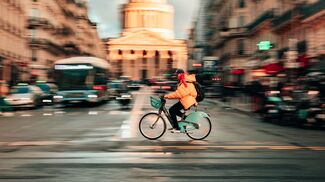
In France, bicycles are sometimes referred to as “soft mobility”. But are they really? Who has never been screamed at by an angry cyclist or collided with a scooter? The receding use of cars in big cities doesn’t seem to have led to any significant increase in overall civility or peace. How can we change this situation? In the wake of the Paris mayor’s recent announcement of a “Parisian street code”, Apolline Guillot draws on Hegel to argue for a new ethics for road users.
A revolution is underway in big cities. The tide of change is shifting in favour of cyclists, after a period during which the urban landscape was largely shaped by and for motorists, says Alexis Frémeaux, president of a French association called “Moving better by bicycle”. This period began in the 1930s, when automobiles went from being an instrument of leisure to a means of mass transportation, and culminated in the 1970s.
Peter Norton, who specialises in the history of urban mobility explains that before the arrival of cars, streets were considered “a public space, open to anyone who didn’t endanger or cause a nuisance to others.” It therefore successfully hosted very different forms of transportation, including pedestrians, horses, and later, trams. These three modes seem to have nothing to do with each other. Yet they coexisted peacefully, in part because they moved at roughly the same speed. Cars, on the other hand, were designed for speed. Driving slowly enough to adapt to multi-purpose streets would negate the very point of buying a vehicle. And so, as Peter Norton explains, “the essential attributes of the automobile (speed, agility) put it at odds with the way streets were legitimately supposed to be used.”
To change this perception, motorists worked on common representations. “Before the big city street could be physically rebuilt to accommodate motor vehicles,” Norton adds, “it first had to be socially reconstructed as a thoroughfare” – namely by redefining what would count as a legitimate and an illegitimate occupation of the roadway. Norton examines the emergence of the term “jaywalker” to describe rogue pedestrians encroaching on the road. Gradually, the street became a place of fast and dangerous transit, where children and informal stall keepers could no longer linger. Soon, cars no longer had to slow down to adapt to the road’s different but coexisting temporalities; it was now the other way around: everyone else had to remain vigilant at all times.
‘After half a century of hegemony, the automobile has left its stamp on big cities’
Mayhem on the pavement
Today, alternative modes of transport are making a comeback. But in the meantime, users have acquired all kinds of bad habits. In the 1930s, cyclists navigated the chaos of the city at low speed, as animals and children constantly crossing the road forced them to maintain a very high level of attention and responsive
…Subscribe to Philonomist and gain free access to all our content and archives for 7 days. You'll also receive our weekly newsletter. No commitment. No bank details required.
You're already subscribed to Philonomist via your employer?
Connect to your account by filling in the following details (please provide your professional email address).
