


is a French sociologist whose research focuses on contemporary changes in work and employment, particularly in relation to globalisation. In Aboard the Giants of the Seas (in French, 2023), she shares her observations aboard large cargo ships.
Picture © CP

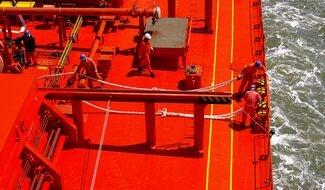
Freelance work, precariousness, administrative burdens, feminisation and globalisation of the profession… These aren’t things we typically associate with the image of the sailor. And yet, the profession is undergoing the same transformations as service industry jobs on land. This is one of the findings of Claire Flécher’s On Board the Giants of the Sea (in French, 2023), based on the sociologist’s time spent aboard several large cargo ships. She sat down to share her observations with us.
Interview by Nicolas Gastineau.
What prompted you to board these boats?
Claire Flécher: There is a blind spot when it comes to work at sea, whether in Marxist studies or in the classics. The importance of maritime trade has certainly been recognised, for example in the works of Fernand Braudel, who showed how the development of ports – even before that of industry – allowed the accumulation of capital and the constitution of a bourgeois class. But the work itself hasn’t really been tackled head-on. The Marxist perspective may have been too quick to think that it was ultimately just a question of transportation, and that nothing very tangible was produced at sea. I wanted to discover and shed light on these lives isolated from the rest of society, which we know so little about, in order to understand what’s happening on the other side of the goods transportation system that irrigates our daily lives.
‘The French merchant navy sector forms a tight-knit community’
Your journey begins with your interview by French sailors, which already reveals a lot about how this community works…
I had just started my thesis and I came well prepared for the interview. I expected to be assessed, but they didn’t ask me any questions about my research project. Instead, they had gone through my CV and picked up on my origins in the Côtes d’Armor [a coastal region in Brittany, France, translator’s note] and my sailing experience! They let me know that they saw me as one of their own, and that this was what counted, and in a few minutes we were already discussing which ship I was going to join.
There was also a test of sorts: if I wanted to do field research on board these ships, I had to be ready to leave tomorrow: a quick yellow fever vaccine, and off you go! This showed two things. First, that the French merchant navy forms a tight-knit community: there aren’t many companies and sailors left – with just three officer training schools (in Le Havre, Nantes, and Marseille). This inter-knowledge is very high and the geographical origin of the sailors remains very much anchored in Brittany, Normandy, and Marseille. This exclusiveness is maintained through a range of myths and superstitions, as well as this imagery of the sailor as an adventurer, very masculine, and always ready to set sail the next day.
Tell us about the ships you spent time on. How are they organised?
I was on board ships carrying petroleum products and others loaded with what we call “dry bulk”, which includes products such as cereals, iron, ore, bauxite, etc. I have also seen palm oil being transported on an oil tanker that wasn’t made for that, but had to adapt as best it could, for lack of a better contract. The navigation and maintenance of the external part
…Subscribe to Philonomist and gain free access to all our content and archives for 7 days. You'll also receive our weekly newsletter. No commitment. No bank details required.
You're already subscribed to Philonomist via your employer?
Connect to your account by filling in the following details (please provide your professional email address).
