


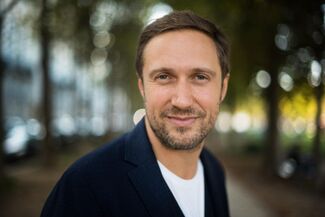
is the director of medical affairs at the University Hospital of Tours. A philosopher by training, a graduate of Sciences Po Paris, and a former student of French School of Public Health (EHESP), he has held management positions in various university hospitals for more than ten years. He is also the author of six social science essays, including “Characters Today” (in French, 2022).
Picture © Astrid Di Crollallanza / opale.photo

Today, managers and HR directors only seem to speak about profiles and behaviours, as if the notion that people also have a “character” (good or bad) has become taboo. Yet workforces are made up of very real and distinct personalities – the temperamental, the witty, the enthusiastic... According to philosopher Frédéric Spinhirny, author of a recent book on the subject, there’s no point trying to assemble teams based on theoretical skills alone, without taking into account the characters that will be expressed within them.
Interview by Apolline Guillot.
At work, we talk a lot about people’s “profiles” or “behaviour”, and rarely about their “character”. Why is that?
Frédéric Spinhirny: We often confuse mood, character, and personality to designate the passive aspect of our social relationships. This is what escapes our control, despite ourselves. In the Middle Ages and especially at the turn of the 19th century, “characterology” was developed as a discipline, to study the way in which a person’s physical constitution, inherited from birth, can inform their way of living and behaving, and even the way they see the world. Today, psychology has taken prime place, and it’s difficult to recognise this passive influence of the body on our mental and emotional states. Now, it’s more often people’s personality that is put forward, especially at work.
But I don’t think the notion of “character” has disappeared. In the same way that an ideology constitutes what we might call “ready-made thought”, a person’s character can be defined as something resembling “ready-made action”: in critical situations, individuals react even before they can control their behaviour. To speak of “personality” is to maintain a rather ethereal vision of the individual. Through the new notions of identity, we like to believe that we could work on our personality, polish it as we want, transform it.
‘I have never met a manager who only manages ‘skills’ and ‘profiles’: on a daily basis, we mostly manage characters’
Etymologically, the term “character” refers to a mark with a hot iron, something we can’t get rid of. By talking about character, do we not risk reintroducing a form of determinism in our behaviour?
Character is attached to the body, while the service-based society as we know it likes to value the most intellectual tasks, precisely to distance itself from the body. But we’re still born with a biological body and its heredities, its metabolism, its history! The 21st century has massively exacerbated the relational factors in people’s constitution. I won’t deny this, but it has also led to a dream of permanent reshaping of the individual – especially through personal development. During my ten years as a manager, including six in human resources, I realised that we manipulate new ideas that can be rather false, in order to close our eyes to the determined part of individuals.
We make fun of the characterology of the end of the 19th century, which indeed was caricatural. But when people keep talking about DNA, diets, or what’s in our brain, to suppress this or that type of behaviour, I’m not sure if we’ve really taken a big step forward. On a daily basis, a team leader necessarily passes through ideal-typical figures which don’t deviate so much from what La Bruyère or Theophrastus described in their Characters, written respectively in the 18th and 4th centuries! We’re engaged in games of social recognition, with the proud, the angry, the hot-blooded... We can give them different names and invent new categ
…Subscribe to Philonomist and gain free access to all our content and archives for 7 days. You'll also receive our weekly newsletter. No commitment. No bank details required.
You're already subscribed to Philonomist via your employer?
Connect to your account by filling in the following details (please provide your professional email address).
