

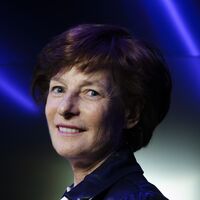
spent twenty-five years as Managing Director of Groupe Artémis, a holding company founded by French billionaire François Pinault. An appreciator of music and art, she also served as CEO of Christie’s (2014-2016) before going on to become chairwoman of the board of the Paris Philharmonic, a board member of Total, and Lead Member of the board of Pernod Ricard.
Picture © Magali Delporte for Philonomist

is a business philosopher with a degree in mathematics (1971) and philosophy (2003) from the Université de Louvain, in Belgium. He’s also a fellow at the Boston Consulting Group (BCG) and the cofounder of the Cartoonbase PR firm, where artists and consultants work together. In his 1985 book Les Infoducs, he already foresaw the convergence of telecommunication networks and the advent of the internet.
Picture © Olivier Anbergen
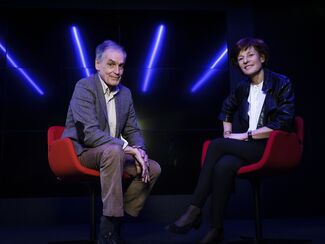
Both a source of artistic inspiration and a vector of these works, today’s new digital technologies are inversely accused of having harmful effects on our cognitive development; while some fear that AI might outright exceed human understanding… What’s at stake in the relationship between technology and creativity? The philosopher Luc de Brabandere and the businesswoman Patricia Barbizet shed some light on the subject.
Chicken or the egg? Creativity or technology? It takes a creative human to invent and then develop new tools. But when they become so developed that they become a source of inspiration for us – as well as an inspiration to themselves, and sometimes even the source of their own development –, the answer is no longer straightforward. Not to mention the harmful effects these digital tools can have on our cognitive development…
To try to untangle the intricate connections between the two notions, we brought together Patricia Barbizet and Luc de Brabandere. The former is a successful businesswoman with a keen interest in art and artists: she led the prestigious Christie’s auctions and now presides over the Paris Philharmonic’s board of administration. The latter is a corporate philosopher who has long been interested in technology and creativity, which he distinguishes from innovation. Together they debate over the chicken and the egg, find similarities between entrepreneurs and artists, wonder how creativity can emerge within a workforce, and try to imagine what creativity might look like tomorrow.
Interview by Anne-Sophie Moreau.
What is creativity?
Luc de Brabandere: Above all, I would like to distinguish between innovation and creativity. I define innovation as the ability to change things, and creativity as the ability to change your way of seeing things. Copernicus had no impact on the solar system. Einstein never changed the world. But they both changed the way we could see it. Innovation is possible without creativity (by simply copying other people’s ideas), and creativity is possible without innovation (in the case of pure science, for example).
Patricia Barbizet: Innovation is part of the logic of results. It answers a need or expectation, which can be more or less defined, by proposing a solution that is intended to be more satisfactory than before. Innovation is therefore not a one-way process: it marks a fruitful interaction between a new supply and a supposed demand. So it interacts with its environment, in a logic of efficiency and achievement.
Creativity is of a completely different nature: it’s the capacity to project without any predetermined objective. Projection in an imaginary or new world, it’s a fiction. Artistic creativity is often the prerogative of one or a small group of individuals. But it finds it’s rooted in a set of memories, impressions, and ideas, from which comes imagination, from which, in turn, comes novelty… This process then takes different forms, which can be echoed from one artist to another. This is particularly true in music: first the composer composes, then the performer expresses what they feel about the work that has been composed.
Can artists alone show creativity?
PB: Everyone is more or less creative. Creativity is first and foremost a way of thinking, even a way of life. It’s an ability to perceive and invent the future – the future of society, people’s lifestyles, our economy… For a long time I worked with an entrepreneur who constantly tried to imagine the world of tomorrow. It was an expression of his creativity. And he had a very strong relationship with artists. It made me realise how sensitive they are to the world, a sensitivity to what the world might become… Artists are often ahead of their contemporaries and their time, even those who practise traditional arts.
‘If you want an idea to bear fruit, you have to stop touching it and visualise what you might produce from this idea’
—Luc de Brabandere
LB: In business, you need creativity and innovation – but all the while, alternating between the two. Someone who changes their mind all the time won’t be able to produce anything. But in a company, we have to produce. This involves temporarily freezing your vision: if you want an idea to bear fruit, you have to stop touching it, and visualise what you might produce from this idea.
Does this logic of production prevalent in companies hold back creativity?
LB: As we produce, the world continues to evolve. And one day, suddenly, you have to change your way of seeing things. And that’s not easy. Take Renault, for example: it’s referred to as a “car designer”. The company constantly releases new models. But is this creativity? When I was 20, during the protests of May 68, we saw this phrase written on the walls: “The more things change, the more they’re the same”. This is exactly what happens at Renault: the more new cars they release, the less they change. I am and remain a car designer! It would perhaps be more difficult for Renault to build a washing machine than for any ordinary manufacturer making cars in a random way, because the latter would have the advantage of not having gotten stuck in a certain posture.
PB: The real pitfall is misnaming things. Often, we think we’re innovating, when we’re just repeating the same model. I would even go a step further: innovative technology doesn’t just offer something new; it participates in the building of a better world. It places itself at the service of human development, by helping people to live better, to answer the imperative of environmental transition, for example. Even if, of course, no innovation is neutral, and everything ultimately boils down to the use made of it.
LB: Exactly. I’m struck by the extent to which things are misnamed, especially when it comes to new technologies. We talk about “autonomous cars” [French for “self-driving” cars, translator’s note]. Autonomy is, for a province or a country, the right to enact its own laws. Imagine if the vehicle could choose its own laws! In reality, we’re producing automatic cars, not autonomous ones!
‘The artist appropriates certain technologies to reveal and give artistic form to their intuition’
—Pascale Barbizet
Does technology feed creativity?
LB: Yes, and moreover, with each new technology there is a new generation of artists. The Lumière brothers’ first film was not a film; it simply showed workers leaving their factory. The first film worthy of the name could only have been made by an artist who broke away from technology.
PB: In the arts, the use of technology contributes to creativity. This approach isn’t new. Painters were able to paint differently after the invention of paint they could take to a field, allowing them to see, and above all express the world differently… The artist appropriates certain technologies to reveal and give artistic form to their intuition. Photography or cinema are testimony to this. We’re seeing more and more artistic applications of technology – which, for the artist, raises the problem of appropriation.
LB: Absolutely. Painter David Hockney, now 84, started painting with an iPad!
PB: Technological tools, even simple ones, continue to feed and renew artistic experiences. Lighting can transform and magnify a performance. I’m thinking of a recent scenic creation by Laurence Equilbey and David Lescot, entitled “Mozart, a special day”... Using the interplay of light and transparency effects, the audience was transported, more than three centuries earlier, to a specific day in the life of the composer. Technology is changing all of the arts. It can be put at the service of a past world, to bring it back to life; and it can be used to break away from the past too…
LB: Take the Beatles’ Sgt. Pepper album: it was the first time that people thought they could make music that there had never been before, thanks to machines.
PB: Absolutely, or before them, the French avant-garde composer Iannis Xenakis, who was also passionate about mathematics and architecture, and who managed to bring together his many technical and creative talents in the post-war period. His orchestral work Metastasis, which lasts about ten minutes, is based on mathematical processes. Other pioneers had already paved the way for electronic music from the early 1950s… But all of a sudden, the creative break meant that a unique character like Xenakis made evident what until then had seemed to be but a field of experimentation.
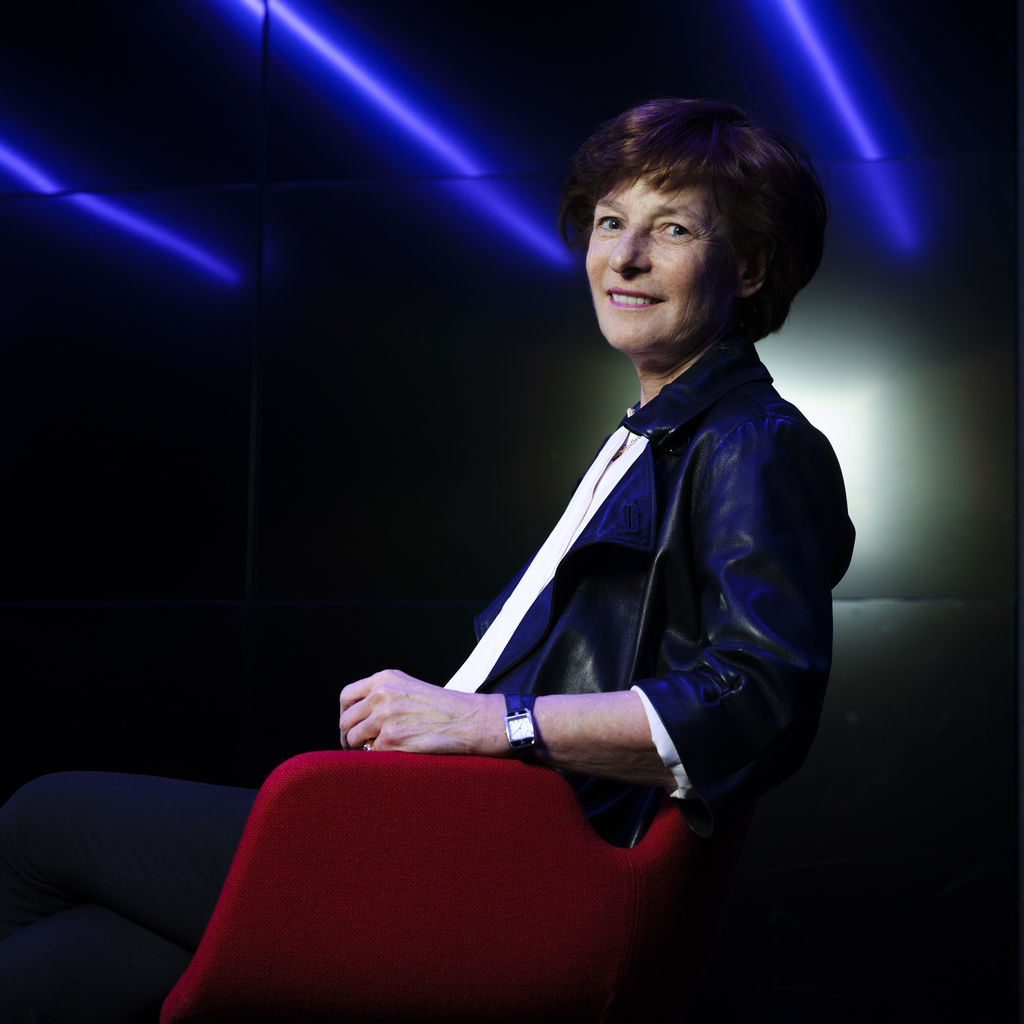
Patricia Barbizet © Magali Delporte for Philonomist
Do artists sense the disruptive nature of a technology before entrepreneurs?
PB: If it’s in their art, yes. Immersive reality has probably been grasped more quickly by some artists than by companies, because it opens up the prospect of unlimited creativity disconnected from all reality. Immersive technologies allow creativity out of time and out of place, free from physical constraints. For example, the “Eternal Notre-Dame” and “L’Horizon de Khéops” experiences, designed by the French company Emissive, immerse the public in Antiquity or the Middle Ages. The luxury sector is now appropriating it, by creating avatars dressed in outfits. On the Roblox platform, under the metaverse, Gucci has organised a “Gucci Garden” to promote and sell exclusive virtual items. But let’s not oppose artists and companies, as there is no competition: everyone appropriates technologies differently.
‘Creativity is a necessary condition for reviving innovation’
—Luc de Brabandere
LB: The artist is obviously freer, because they don’t have to present financial results. This allows them to take technology further. At first, we approach new technology with old mental models. The natural tendency of human beings is to add to what already exists. Nobody ever invented the bicycle: the first machine that resembled it, the velocipede, was a tool designed to make the feet go faster; then one day on their way downhill someone thought: “but actually, I don’t even need my feet!” And that’s how the bike was born.
The first railroad cars had ten doors, because the mental model of the time was the stagecoach, which had two seats and two doors. I like to take the example of oil: when we discovered it in the 1860s, we started by burning it. We saw it as improved coal. The real oil revolution happened thirty years later, when we thought of blowing it up and transforming it.
Innovation takes place within a given framework, and initially you can’t touch it, otherwise you won’t make anything at all… But then there comes a point when another framework is needed, and this new framework is brought about by creativity. Innovation in itself is doomed to fatigue. At Gillette, when sales drop, they just add another blade! But after a while there’s nowhere else to go... At Bic [initially a plastic pen company], they said to themselves: “Basically our job isn’t writing, it’s making disposable things”. So they started making razors. Creativity is a necessary condition for reviving innovation.
PB: And vice versa: the new framework will enable innovations that will feed the next creative leap. The two go hand in hand and each is strengthened by the other.
LB: Absolutely – that’s why I subtitled my book on digital transformation “how to (re)discover the art of the zigzag” (A short philosophy of digital transformation, in French, 2019). Gaston Bachelard showed that there is no continuity from the candle to the light bulb, because to move from one to the other, you need to break the working hypothesis which was dominant for two thousand years: “if I want to create light, I have to burn.” To invent the light bulb, we had to change assumptions and ask ourselves, “but can’t we create light by preventing something from burning?” Edison said he had invented five hundred ways not to make a lamp. So yes, in a way, the bulb looks like a kerosene lamp, but in reality it’s mentally inaccessible to jump from one to the other: you have to do a zigzag!
‘Procedures protect large companies against risks, but they strongly impede innovation’
—Pascale Barbizet
Large companies are often accused of killing creativity internally. Why?
PB: The employees of large companies are just as creative as the others. Large organisations, often very creative in their field, sometimes tend to stifle initiatives... This situation is mainly the result of procedures. They’re an exceptional asset, because they protect large companies against risks, but they strongly impede innovation. Rules, controls, and processes are too heavy for a start-up. It’s the syndrome of the stone that crushes the flea!
These big companies have also noticed this and many of them have decided to design “digital factories”: specific places, outside the company, where young startups are given a specific objective as well as the means to work towards it. Large companies and startups, each in their own world, have therefore found a way to have the best of both worlds: on the one hand, creativity and speed without too many constraints; on the other, the possibility of integrating and supporting innovation in its technological, financial, and organisational growth.
LB: The problem with large companies is that they issue paradoxical injunctions: to tell someone to be creative is to give them a rule which consists in not following the rules!
How can we support the creativity of young entrepreneurs?
PB: Listening and freedom are essential assets to support the creativity of young entrepreneurs. We need to encourage them to bring out and implement their ideas. You have to direct them towards the right questions and, if necessary, redirect them; and of course, give them a network to help them progress. The collective aspect is crucial: entrepreneurs most often work in a network, so they feed on this interaction with others. I think this collective spirit is based on a human trait: those who have ideas like to share them. And they’re all the more willing to share them when they know that more ideas will follow!
‘Having a lot of ideas and knowing how to choose the right ones are two different jobs’
—Luc de Brabandere
LB: Having a lot of ideas and knowing how to choose the right ones are two different jobs. I really believe in tandems. It’s no coincidence that there are so many brothers who innovate together, like the Lumière brothers. Jules Verne said he wouldn’t have become who he was without his editor, called Hetzel, who alone was able to tell him if his latest novel was too long or too similar to the previous one. At Accor, where I worked, I was fascinated by the connection between the company’s founders, Paul Dubrule and Gérard Pélisson: one used to be dispersed in every direction, and the other used to tell him “that’s enough now!” It was great fun watching them interact. In our “thought labs”, we brought together those who have ideas and those who know how to spot the good ones.
PB: There is indeed the person who has a lot of ideas, on one side, and the one who knows how to make sure they succeed, on the other. One brings the what, the other the how. Such was the case with my relationship with François Pinault, who had a very forward-looking vision. He set the goal, and I was responsible for saying where we were going to go, in order to reach it. Over the years, I have noticed that business talks often break down because we focus too much on the starting point: we spend too much time noticing the differences. From my experience, I find it works better when you first develop a vision, specific objectives, and in a sense, start from the end point.
LB: It remains to be seen how we can know the point of arrival…
PB: And this is precisely where we need creativity!
LB: We call “induction” the thought that starts from the point of arrival. The difficulty is that there is no science of induction. Intuition means taking a risk: we cannot determine with certainty whether the point of arrival will be the right one.
‘Creativity has a logic, but we only understand it afterwards’
—Luc de Brabandere
Is the intuition of the entrepreneur comparable to the creativity of the artist?
PB: Intuitions are forms of creativity because they share a common origin: sensitivity. Sensitive experiences lead to intuition, to this “presentiment which makes us guess what is or should be”, as Balzac said. Intuition is therefore not based on deductive logic – and this is true for the entrepreneur and the artist alike. On the other hand, their intuitions are of a different nature because their purposes are different. The entrepreneur’s intuition is utilitarian, it is at the service of a cause: the corporate purpose of the company. The artist’s intuition doesn’t have this utilitarian function; it finds its practical application in the work which is unveiled to the audience.
LB: There is a huge difference between creativity and intuition. Creativity has a logic, but we only understand it afterwards. We often say “but why didn’t we think of that sooner”? When I was a child, suitcases didn’t have wheels, although it became obvious to us later... But you didn’t have to be a rocket scientist to think about it! The problem with creativity is not that it’s illogical, but that we don’t have the right logic at our disposal. Intuition is very different: even afterwards, we don’t understand its logic.
PB: A good idea can’t necessarily be deduced from the technologies involved.
LB: I would say that no idea is born good.
PB: I absolutely agree with you on that!
LB: Intuition and creativity produce something new, never good. There are always two stages. Before you can say if an idea is good, you must first accept the novelty of the idea, the fact that it troubles you a little and that you’re even a little afraid of it. Then, there are two possible stances: the “yes but”, or the “yes and”. The second offers a chance to arrive at the right idea. But these are incompatible postures: if I look for a new idea and at the same time ask myself if it’s good, it doesn’t work. It’s as if I were braking and accelerating at the same time! When you lead a group creativity session, you have to know which mode you are in: divergence or convergence. Otherwise the meeting could be very disappointing.
‘The most creative people have the ability to capture all the elements of what they see and perceive and transform them’
—Pascale Barbizet
PB: The most creative people have the ability to capture all the elements of what they see and perceive and transform them by asking themselves: “what can I do with them?”, “what can I think of them?”, “what can I say?”. It seems to me that this is a very particular state of mind. One which is probably innate, but which is skilfully maintained by creative people. A fruitful state of mind, because it transforms a feeling into creation.
LB: That’s exactly it. You have to “capture”, which implies being open, looking elsewhere. While logical thinking is deducible, intuition often works by analogy. I really like the story of Lavoisier, from which we retained the formula “Nothing is lost, nothing is created, everything is transformed”. He worked as an accountant, hence the particular way in which he thought about his chemistry notebooks, which were structured like a balance sheet. But thinking by analogy isn’t a decision-making tool: just because your competitor is doing something doesn’t mean you should do it. The fact that they’re doing something different should lead you to ask yourself what it makes you think of, and then, to ask yourself “so what do I do?”
‘Formatted material dries up children’s ability to build their own imagination’
—Pascale Barbizet
Technology is often criticised for drying up creativity, especially that of children. Should their access to technology be limited?
PB: All technology has its limits, especially for children. Creativity needs dreams and imagination. Children who constantly watch the same cartoons on a screen will not be creative. Formatted material dries up children’s ability to build their own imagination. To stimulate it, on the contrary, they have to read books, play in the street, look at butterflies... We don’t have the same representation based on a book or a film: I had the chance to read Gone with the Wind before seeing the film and I basically kept two different images of it. I have my two Gone with the Winds, so to speak… The brain develops so quickly between the ages of 0 and 6 that you have to take advantage of this to activate all the areas that will need sensors. There are therefore many limitations to the exclusive use of any given technology for too long.
On the other hand, each innovation also brings something different. It was true of photography, television, and cinema. Because there comes a point when technology also carries within it a work of art, a work of imagination that is created according to its new rules. Cinematographic storytelling became an art when it appropriated the medium and made it something that met certain criteria – a story, a rhythm, a use of all the different means…. It’s the use of technology – and not passive observation – that gives a child or an adult the ability to project themselves into another world and to assert their imagination based on something they’re telling people, using different means.
‘Do we use the internet or does the internet use us?’
—Luc de Brabandere
LB: I would say that children shouldn’t be left alone in front of screens. The very first book I read on the subject, Mindstorms, by computer scientist Seymour Papert, is already forty years ago. At the end of the book, he posed the question: “Who is programming who?” Is it the child activating things on the screen with their mouse or is it the screen which, through messages, causes the child to activate this or that? This is valid today: do we use the internet or does the internet use us? We must answer this categorically: it’s the child who programs the machine, it’s the man who uses the tool, and not the other way around.
However, it’s impossible to lay down general rules regarding technology. When we ask ourselves if comfort is needed to nourish creativity, we can answer with yes or no. Ditto when you wonder if it’s better to be alone or in a group to be creative, or if you need knowledge to invent something new. Likewise, it’s impossible to give a categorical answer to the question: “Is technology good or bad?” I want to say it’s good and bad. The internet is both good and bad; it all depends on what you do with it. You can’t discard it: you have received something incredibly powerful and dangerous at the same time. Parents, teachers, grandparents… They need to take responsibility!
PB: Support is very important. This is true for children as well as adults. Even when you’re alone, the inner dialogue with yourself is fruitful. Because this dialogue implies an evolution of the way we look at ourselves or at the world. Here we find the role of those “sensors” that artists have, which I mentioned earlier.
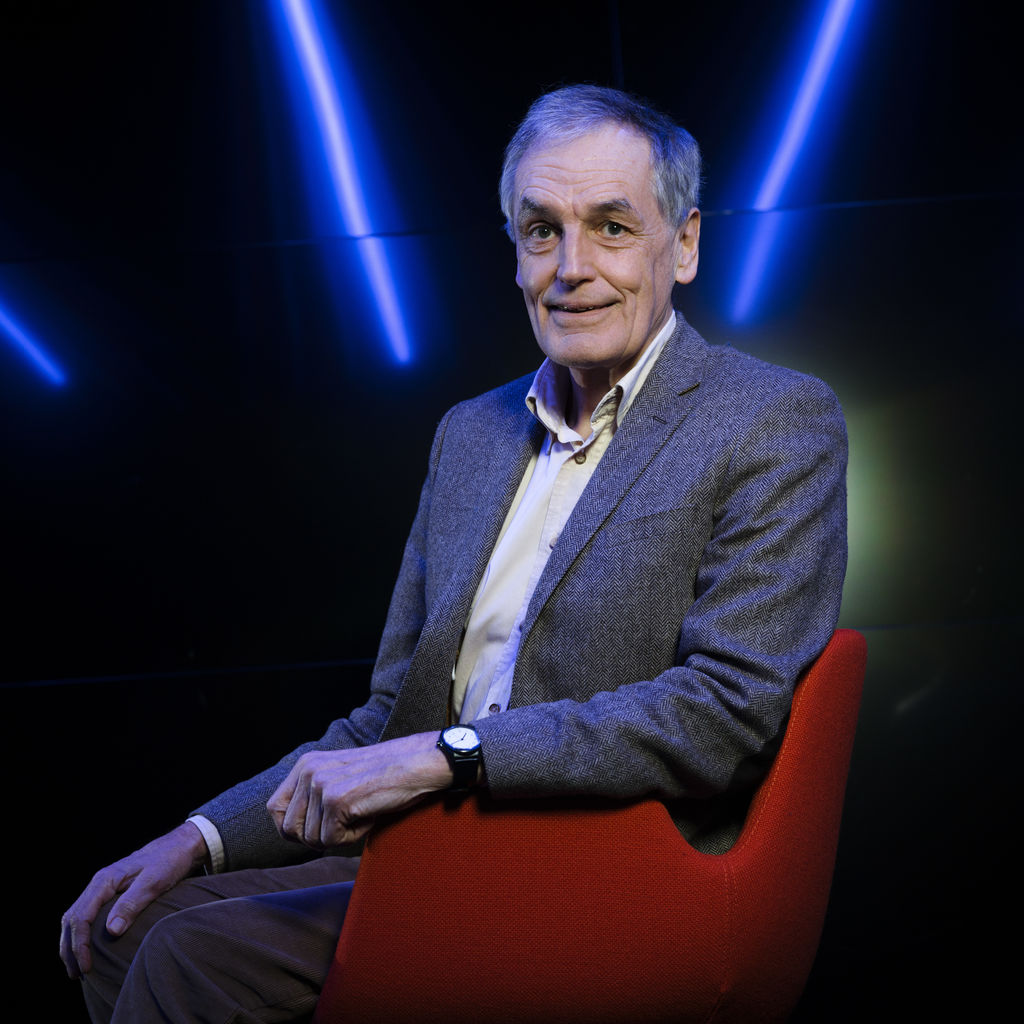
Luc de Brabandere © Magali Delporte for Philonomist
What is specific to the aesthetic experience, and how can it be transmitted?
PB: The essence of a show is precisely to be alive. Aesthetics relies on the use of artistic means to express something. To reveal a conception of the world. To reveal one of its facets. It’s the role of the director or visual artist to use all the means at their disposal to say something in a different way. This aesthetic takes as many forms as there are forms of art… There is an aesthetics of language, an aesthetics of composition, an aesthetics of staging, etc.
LB: When people talk about aesthetics, I always think of Schopenhauer. The philosopher said that there were two forms of suffering, both of which revolve around envy and possession. The first is not having what you want. The second, which is much more serious, is to no longer desire what one has. For Schopenhauer, the only way out of this is to desire what you have, which is paradoxical. And the only solution to desire what we have is aesthetics. There’s nothing worse than feeling bored with a bottle of champagne! It’s better to cultivate the pleasure of beauty.
‘That’s the magic of the show: experiencing something together’
—Pascale Barbizet
What do you look for when you go to see a live show?
PB: We go for several reasons… First, to grasp what the artist, the director, or the performers are trying to express through their work. Then there’s the collective part. This is what was so difficult during lockdown: the collective dimension was lost… Take the cinema: we could watch a film at home, yet we choose to go to a room full of people who are all there for the same thing. When the room goes dark, something happens. It’s a whole different power of shared feelings than when you watch it on your own screen, at home.
It’s the same in the performing arts: there is something alive on stage, and something alive in the room. The big festivals, the big halls allow a communion and sharing among people who don’t know each other. That’s the magic of the show: experiencing something together. We can clearly see this in today’s post-Covid world: the difficulty in filling cinemas or performance halls reflects a more general malaise in society, which was amplified by the pandemic. More individual than collective uses have led to profound transformations.
Can capture technologies reproduce this magic from a distance?
PB: There are some wonderful initiatives that allow culture to be disseminated to a wide audience. This was particularly true during lockdown: the reruns of shows acted as a link, like a hyphen, with life. Many Philharmonie concerts have been filmed. This makes it possible to create or recreate a special connection between the room and its audience, including with a new, more occasional audience. Technologies allow us to form a community around such moments of sharing.
LB: I remember the New Year’s concert in Vienna. The orchestra played The Blue Danube in front of a completely empty hall, with all the musicians, as if there were two thousand people.
PB: But there were millions of people watching from a distance!
LB: The conductor spoke and talked about the importance of live concerts. It was very moving, despite the distance.
‘The deductive part of intelligence is very well mastered by machines, but not creativity’
—Luc de Brabandere
Will technology itself, for example AI, ever be creative?
LB: I don’t think so. I don’t think we should use the term “artificial intelligence”; we should talk about an artificial intelligence. A doctor, a lawyer, or a consultant can get help from an AI, but AI in general does not exist. The term “intelligence” appeared two centuries ago, when the first research was done to invent the intelligence quotient (JQ). At the time, an intelligent person was someone who knew how to do mathematics. After the war, this vision was questioned by focusing on multiple intelligences. Today, we’re tempted to put intelligence back in the singular, and that’s a shame.
The deductive part of intelligence is very well mastered by machines, but not creativity. I don’t see how you could program intuition, and that’s why I think you’ll never find it in machines. In fact, the first movement of thought is forgetting. There is a short story by Borges called Funes the Memorious, which tells the story of a man who has an infinite memory. This character realises that he no longer knows how to think because he remembers everything. Forgetting is essential to thought, yet it cannot be programmed. AI can’t forget, so it can’t think.
‘To assert that AI is a lever for creativity doesn’t mean that as creators of AI, we’ve been surpassed by our creation’
—Pascale Barbizet
PB: I’m less clear-cut about AI than you... Among its many applications, it allows us to increase creativity, conceive and propose new ways of accessing the world. Some works which will be the product of technology wouldn’t have existed otherwise. But to assert that AI is a lever for creativity doesn’t mean that as creators of AI, we’ve been surpassed by our creation. The new forms of digital art that are emerging now show this.
Take the French collective of three artists and researchers, Obvious, who use AI as a creative tool. The algorithms they write create unique works of art, which leads to a double creation: human creation, which shapes AI, and the creation of the AI itself, which is derived from the human mind. AI represents a considerable mutation. We’re witnessing the development of a delegated imagination. The artistic result is still the expression of an imagination, of particular impression and sensitivity. It’s the way these feelings are expressed which are destined to evolve thanks to the machine.
LB: But there will always be the problem of writing the algorithm. I can’t see an algorithm writing itself… There are always starting premieres, an impulse. What would the world look like if all the algorithms in the world were written by women? But who can give the impetus? For me, there are two limitations to AI: a technical one, creativity; and a philosophical one, that of responsibility.
Picture © Magali Delporte for Philonomist
