


is a sociologist, professor at the University Paris-Diderot and member of the Institut Universitaire de France. Known for his analyses of conspiracy theories and belief, he recently published On Origins. Why Do We Become Who We Are? (in French, 2023), in which he looks back on his transclass journey and reassesses the notion of merit.
Picture © Edouard Caupeil/Pasco
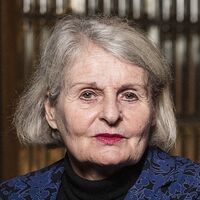
is a philosopher, specialist of Spinoza, and professor at the University Panthéon-Sorbonne. She coined the term “transclass”, to reflect her own experience. She talks about her journey in a book made of interviews In Passing (co-written with J.-M. Durand, in French, 2021) and co-edited the collective work titled The Making of the Transclass (in French, 2018).
Picture © Edouard Caupeil/Pasco


Having both come from working-class backgrounds to become prominent intellectuals, sociologist Gérald Bronner and philosopher Chantal Jaquet have both written about their unique journey. In his recent essay On Origins. Why Do We Become Who We Are? (in French), the former deconstructs what he sees as a prevailing miserabilist discourse, to instead reassess the importance of merit. The philosopher, who coined the French term “transclass”, responds.
Interview by Cédric Enjalbert.
When she received her Nobel Prize in Literature, the French author Annie Ernaux said that through writing, she wanted to “avenge her race”. What does this ambition mean to you?
Gérald Bronner: By repeating that she wants to “avenge her race”, Annie Ernaux shows an anger in which the motive of revenge appears. The claim comes from a form of mythogenesis – a way of recounting one’s journey. I’m not saying it’s false, I believe in the suffering it exhibits. But it illuminates only one facet of the polyhedron that is identity. All these authors read each other: Annie Ernaux experienced an ontological shock whilst reading Bourdieu, then Didier Eribon, by reading Annie Ernaux, and Édouard Louis, by reading all three, so that a stereotypical narrative matrix is formed. This can be a dead end for those who set out to find themselves.
Chantal Jaquet: With this expression, Annie Ernaux intends to overcome the feelings of shame and pain, to break the sense of social fatality, to rehabilitate her own people and assert a form of pride. This isn’t an expression that I would use, personally, because it’s less about taking revenge on the past than asserting a power to act through writing. But neither shame nor pain are shameful, because emotion has a truth which expresses the way a situation is experienced. The writer is re-appropriating her story and regaining self-esteem, by sublimating her emotions thanks to the brilliance of a literary work and the invention of a “flat” style writing, which have their own force, irreducible to any stereotype.
G. B.: I’m not denying the truth of the emotion. As a sociologist of beliefs, I’m observing that there can be an intellectual alienation in the expression of dolorism. This Christian exaltation of suffering – the idea that in order to be a legitimate social hero, one should have to suffer – seems obsessive to me.
‘A free being needn’t be ashamed nor proud of their origins’
—Chantal Jaquet
C. J.: The concept of transclass describes a process of passage, not an essence or a nature. There is therefore no obligatory feeling. Among the emotions that play a role in the transclass trajectory, I first insist on love and friendship for beings different from ourselves, which make it possible to detach ourselves from the primary models of identification. I also highlight the anger and the feeling of injustice evoked by the African-American novelist Richard Wright [1908-1960]. Shame is ambivalent. It can just as easily lead to an erasing of humiliation as it can to a withdrawal within oneself. I agree that a feeling of this type, if it becomes an ethos or a permanent inclination, has terrible effects. Shame can be an engine or a poison. That said, I would be wary of any moralisation of transclass people, saying that they’re inclined by nature to dolorism, that they should take responsibility for themselves rather than vent their feelings. Being able to express one’s emotions without self-censoring is a necessary condition to freeing oneself from them. Being ashamed of being ashamed is a step towards regaining pride. But, in absolute terms, a free being needn’t be ashamed nor proud of their origins.
G. B.: In the collective book that you coordinated [The Making of the Transclass, in French, 2018], the word “shame” comes up again and again. Just as psychoanalysis can trap us by locking us into the story of a personal drama that would explain all our impediments, a certain number of transclass people feel obliged, in order to feel legitimised, to exhibit their suffering. The human brain has a taste for monocausal explanations. Having gone in search of our origins, we seek the primum mobile of our personality, the cornerstone on which it’s built, and we’re therefore tempted by many typical stories. We both come from working-class backgrounds, and I could have given a painful twist to my story. My mother was a housekeeper, we lived in the suburbs, in a very modest environment, but it wasn’t miserable.
C. J.: And your father?
G. B.: He left when I was five years old. When my mother was alone and unemployed, sometimes we had milk and biscuits for dinner, but for us it was like a celebration. We can tell our own story in a thousand ways, including in a miserable way, if you like. But I’m suspicious of self-fulfilling stories, which entertain a sense of suffering, as well as the bias of self-indulgence, which consists in explaining our failures by the wickedness of others and our triumphs by our own strengths.
‘If many stories of transclasses mention shame, it’s because, for the first time in history, we have the right to talk about it’
—Chantal Jaquet
C. J.: If many of these stories mention shame, it’s because, for the first time in history, we have the right to talk about it. In the past, transclass people had more of a tendency to show pride. During this symposium at the Sorbonne on how transclass people come about, I saw researchers dare to come out of the woodwork, and confess what no-one dares say. It’s not that shame has come to dominate; it’s a liberation of speech.
G. B.: But everywhere, we see the same authors and the same references. Does this narrative conformism not surprise you?
C. J.: No. I see a lot of diversity in what I’ve
…Subscribe to Philonomist and gain free access to all our content and archives for 7 days. You'll also receive our weekly newsletter. No commitment. No bank details required.
You're already subscribed to Philonomist via your employer?
Connect to your account by filling in the following details (please provide your professional email address).
