


is the president of Adecco, the world’s leading temporary work agency. He joined the company in 1995 as an intern auditor, before climbing the ranks.
Picture © Laurent Villeret for Philonomist

is a philosopher, author, and lecturer. She has also worked in human resources for several years and written several books (in French) about philosophy in the workplace, personal development, and the question of identity.
Picture © Hannah Assouline / Opale / Leemage
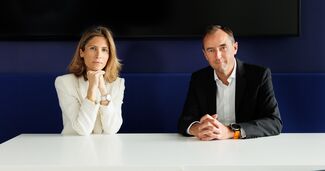
Recruitment, assessment, remote work, AI, data management… Technology is transforming the world of work in depth. In the following conversation, Christophe Catoir, president of the temporary work provider Adecco, and the philosopher Julia de Funès analyse these changes as well as some of the issues they can lead to.
If there’s one area of activity one might expect to remain human, it would surely be that of human resources; and yet, like many others, recruitment and management positions have been shaken by the rapid growth of new technologies. The advent of remote work has forced many businesses to rethink their organisation and managers, their methods. All kinds of new tools – linguistic analysis, recruitment algorithms, data management – have been reshaping the way in which we interact; not to mention the deeper and less visible transformations at play, which we can only imagine.
To help us analyse these developments and form a clear idea of what might be at stake, we turned to two human resources heavyweights: Adecco president Christophe Catoir, who rose through the ranks to become the head of the world’s biggest temporary work agency; and Julia de Funès, a philosopher who worked in HR for over ten years before dedicating several books to the working world.
Interview by Anne-Sophie Moreau and Sophie Gherardi.
What have technologies disrupted, or what will they disrupt in the world of work?
Christopher Catoir: The technologies that are transforming the world of work are firstly transforming the content of work and the skills required for certain jobs. Whether in the industrial sector, in construction, in the service sector, there are now such tools as automatons, digital interfaces, programming, and data management that are shaking up the ways in which we work. So much so that access to certain jobs is becoming tricky for people who have already exercised them for years.
Let’s take three examples. The first is maintenance in the industrial field. Before, we used to open up the machinery to repair it with a screwdriver. Today, we have moved to predictive maintenance: wear and tear is calculated according to the number of uses; a computer determines when the breakage rate is going to be reached and the part is changed even if everything is working. The nature of the profession has therefore completely changed. This first technological brick is found in all industries.
My second example relates to recruitment. Historically, the meeting between the recruiter and the candidate took place in an office, a shop or a workshop. To be selected, all that was needed was a warm and convincing handshake. Then we saw the emergence of job boards, these websites which combine the offer and the demand for employment. They lead you to position yourself differently, because you have to know how to use this mode of intermediation, without resorting to the seduction games you usually play during the interview.
‘Companies are therefore managed according to something that doesn’t yet exist, which is completely virtual’
—Christophe Catoir
A final example is data management. We see models arriving where it’s no longer the order book that justifies recruiting new employees. It’s more about the predictive management of what your order book could be tomorrow. And there, only the algorithm really knows. Companies are therefore managed according to something that doesn’t yet exist, which is completely virtual.
Julia de Funès: Remote work, made possible thanks to digital innovations, is changing, beyond the tools, our conceptions of work, of the company, of management. It’s a global upheaval, which affects time, space, and our relationships with others and with oneself. By mixing work and home life, by making work less a place than a time, remote work is desacralising work. Life is no longer what’s left, at 7 p.m., once you leave the office. Life is taking over work, and paradoxically, it’s returning to work its full meaning – as a means, and not as an end, as we have tended to see it for years! Working for the sake of working makes no sense. If our work has meaning, it means that it answers to something other than itself, and we are in the process of putting it back into our lives.
Remote work also requires a relationship of trust. Now that they no longer have employees under constant watch, managers are forced to trust them. Very controlling managers have a hard time letting go, even when trust pays off! When we trust, the other feels invested by the trust received and wants to show themselves worthy of it. Of course, moments of control remain necessary, but the general work climate is evolving towards more autonomy. Whether it’s in the personal meaning one gives to one’s work, or in one’s managerial relationships, this way of working is shaking up old paradigms.
What will happen to recruitment in the age of algorithms?
C. C.: After 27 years in the recruitment sector, I see that we have replaced face-to-face meetings with a rather rough model: if you match enough keywords, your employability increases; if you don’t have them, it decreases. This creates a very sanitised world, at a time when there’s a lot of talk about diversity. PR promises and recruitment methods do not converge, and decision-makers in companies are not necessarily aware of this. If you’re content to collect a CV supposed to summarize a life, a career, you will not find what, even in the opinion of companies, makes the success or the failure on the job.
So data technology can be useful to understand the person from a much broader spectrum than the CV, allowing us to reopen on diversity. There is still hope, provided that technology is used as a support and not an end. If I had a single dream in my company, it would be to be able to detect the full potential of each candidate. I’m arguably more equipped to do this with technology than productivity-based business models, especially when you consider how career counseling and initial education work. I still see a promise behind all this!
J. F.: I totally agree with your promise. It’s up to us to make new technologies; not autonomous powers that would compete with our intelligence, but ways to get rid of – as much as possible – the purely procedural, to privilege what we have in us that is specifically human, namely emotions, intelligence of action, intuition, and everything that is not rational but “sensitive”.
‘Recruiters were like a low-end AI machine, minus the algorithmic power’
—Julia de Funès
If I take the example of recruitment, in which I worked for ten years, some eminent recruiters sometimes boasted of an ability to sense, using their flair or intuition, but very often they overlooked it for fear of risk, leaving room only for objective, rational, "Pavlovian" criteria, such as the keywords, recognised schools, similar experiences… Recruitment, which was intended to be an art, a skill, was reduced to a well-oiled mechanism. The decision was only a replication, the selection of cloning candidates. At the end of the day, recruiters were like a low-end AI machine, minus the algorithmic power. Thanks to AI, perhaps we will finally manage to make our intelligences less artificial!
Artificial intelligence (AI) is accused of fostering misogynistic and racist biases, among others. How can we use it whilst keeping with the requirement of diversity?
C. C.: Building algorithms that are supposed to be smart and applying them with blind confidence is a tragedy. I’ve seen companies say, with good intention: “I give the same test to all the candidates I interview and to all the employees of the company. I then see their individual performance and can determine which typical profile is successful.” As a HR director, this is the promise of having the clone wars! If that’s your ambition, AI will be a good friend, because it will reproduce your wish to the point of caricature.
The problem is twofold. On the one hand, it creates an ethically unacceptable pattern of exclusion, which is not part of human nature and should not exist in our conception of work. On the other hand, it’s a model of which you are no longer the master. The algorithm is machine learning: little by little it learns, it retains, and in the end the complexity is such that we no longer know what led to choosing certain candidates rather than others. And it backfires on you. If AI ends up duplicating clones, you might as well have robots and give up on the diversity that can be found among colleagues. AI centred on such a system doesn’t make sense. Conversely, if it’s based on an educational model, it can make sense. For example, we can, through the writing of texts, identify where the strengths are and where the weaknesses are, detect certain criteria that make you reluctant to write and very open to reading... You have to adapt to the individual, and artificial intelligence can help us do that.
‘Relying entirely on a technology like semantic analysis to understand an employee or assess management seems risky’
—Christophe Catoir
After recruitment comes the rest of the career: can we replace individual interviews with semantic analysis, to judge the work of a person?
C. C.: Here too, relying entirely on a technology like semantic analysis to understand an employee or assess management seems risky. There are digital coaching methods, but at the end of the day you need a real coach who will define and follow real goals. Moreover, for the employee to appropriate this mode of coaching, they must have the impression of having been understood. It takes embodiment to engender trust. I’m not very optimistic about the managerial role of technology. It can help provide support for the evaluation. But you have to have a discussion about the criteria you use. For me, the decision must belong to someone who is trying to build a homogeneous whole out of individual workers. And that’s difficult.
J. F.: As for me, even real coaches don’t reassure me – quite the contrary! Too often, crowds of phoney coaches drown our singularities in proven behavioural kits, agreed methods, colour classifications and other silly trinkets that reduce the individual to a standard pattern and the self to an exemplar, until they’re chloroformed in conventional postures. In your answer, you quietly moved from digital coaching to coach to manager, and indeed I believe your shift is telling. Only the manager who experiences the job first hand can understand the issues, and build, as you say, a homogeneous team. Only they can “judge” the personal work carried out.
Finally, AI tools are great for analysing, comparing, and diagnosing; they’re less useful when it comes to grasping the irrational part inherent in each human. If I take your example of pedagogy: the same student can encounter difficulties with one teacher, and become excellent with another. A student can love a subject with so and so and hate it with another teacher. Of course, none of this is algorithmic logic.
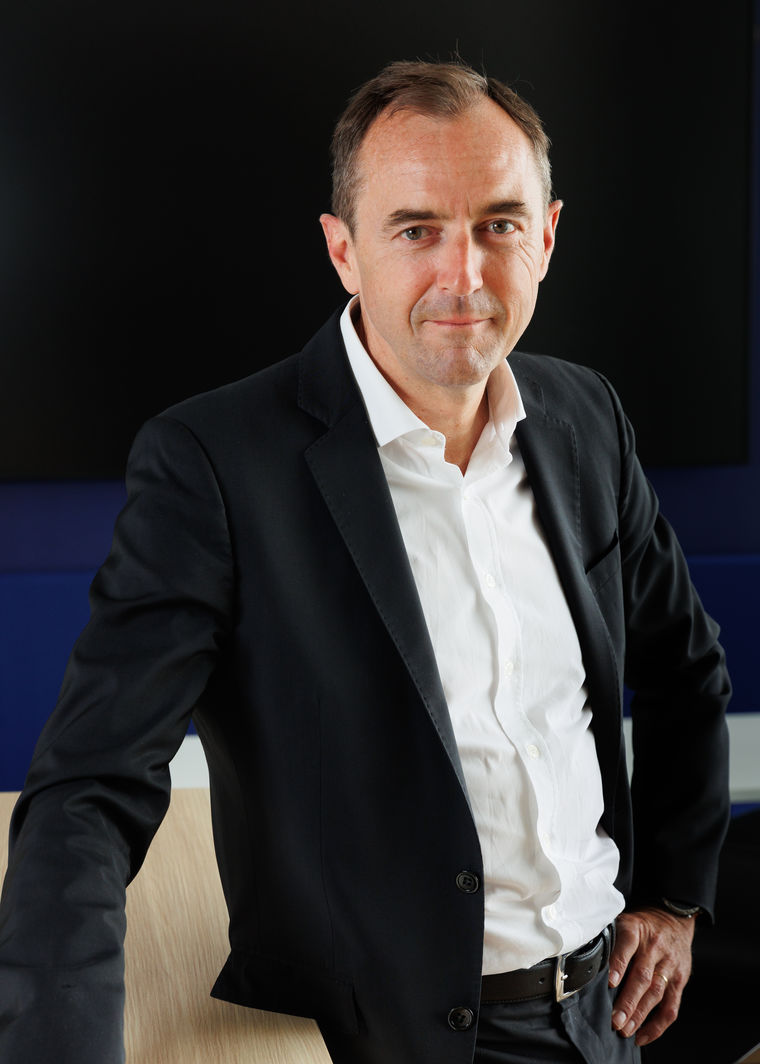
Christophe Catoir © Laurent Villeret for Philonomist
C. C.: Our culture is very emotional: people react more with their hearts and guts than with their heads. When you have the ability to speak to people’s hearts without manipulation, they feel it right away. And if you’re fake, it also shows. In the industrial sector, we find cultures based more on the rational, i.e. facts and figures. But other levers are effective. You can’t model everything, nor should you want to. What makes the difference is also the pleasure at work, finding an environment conducive to one’s personality, to one’s mode of development. Can technology probe that? I’m not sure that’s its role.
J. F.: Unfortunately, we didn’t wait for AI to “think” in terms of rational modelling. I have never enjoyed purely quantitative personality tests or debilitating colour tests: you’re red, therefore you’re brave; you’re blue, therefore you’re generous… I find this distressing! All these models classify, order, encompass, summarise, without understanding anything about human complexity. Take the example of charisma. Charisma is about style, authenticity, personality, and the courage to be yourself. It can’t be modelled, it can’t be quantified, it can’t be colour coded! It depends on existential conditions that are much more complex and very often irreducible to diagrams, graphs, curves, pie charts, sets and classifying subsets!
These techniques used are believed to be personalising… But they’re basically de-personalizing. They’re impersonal in that they standardise, homogenise, generalise. They are addressed to the “I” of each person as they do to millions of others. They schematise the human being, who can therefore no longer be fully human.
‘Distance restores vigour, interest, and efficiency to collective moments’
—Julia de Funès
Does remote work make relationships more difficult?
J. F.: Contrary to the idea, which has become cliché, that remote work hinders collective cork, I think that, on the contrary, it strengthens it. It’s too easy to use remote work as an excuse for an organisational difficulty. Remote work certainly makes it more difficult to organise collective moments, but in no way does it prevent them.
First, in France, few people work remotely five days a week. There are still moments of presence. Second, being face-to-face has never guaranteed a strong collective: in open plan offices, people can be a metre and a half apart and still prefer to send each other an email so as not to disturb everyone – which amounts to doing face-to-face remote work!
Third, virtualising and distancing relationships makes them all the more expected, desired, and desirable. This is true in friendship, in love, and at work. When we’re in continuous presence with each other, a certain weariness can be felt. The fact of being deprived of the other fuels the desire for reunion. You have surely noticed, like me, the pleasure people had in meeting up after being stuck in lockdown. Well, when you know that you can only see your colleague once or twice a week, meetings are generally more efficiently conducted. In this sense, the distance restores vigour, interest, and efficiency to collective moments.
C. C.: Today, you have to pay attention to people, who are becoming a scarce resource! The challenge for companies is to manage to organise themselves in such a way as to satisfy each employee, whilst still achieving a collective objective. Before, the unions would discuss whether we were to have a day or a half-day of remote work per week. The crisis solved the problem: they got five days out of five! But extremes are never satisfactory. Some companies have wanted to put everyone on remote work all the time, seeing it as the new mode of employment and perhaps as a way to be more popular. It’s an illusion. We need others, to see each other, to touch each other, in order for energy to circulate.
Conversely, it would be a mistake to want to go back to negotiating the day or half-day of remote work. Some have realised they never enjoyed going to the office at fixed times and meeting the same people every day... And as the company needs motivated and committed people to succeed, it also needs to address the demands of each employee. But in keeping with a collective mission: making a newcomer work remotely isn’t a good idea, for example, because they need to see how the job is expressed, in order to be taken on board by real people and not by a digital interface. It’s very different for someone who already has experience of the job.
J. F.: The reason for working from home is flexibility. It would therefore be paradoxical, if not senseless, to make it a procedural straitjacket! In my opinion, remote work has, beyond the known advantages (saving commuting time, etc.), another major advantage: a psychological release. For years companies have been glass cages, where everything is transparent, where we’re always visible. However, it is enough to know that we are visible to act as if we were seen. This explains a large part of the human comedy, the theatricality that is still played out in companies – face-to-face meetings for the sake of it, etc. Remote work reduces this part of the game, by favouring a culture of results. It acts like a sieve: no matter how I look, my location, my schedule, what matters is the result of my work. In this sense, it liberates and makes working relationships more authentic and professional. Remote work nevertheless has drawbacks, such as the amplification of social inequalities and the difficult reconciliation between private and professional life.
Does remote work promote distancing and therefore a certain disloyalty towards the employer? It’s often said that young people prefer to work freelance, and that employees are less and less loyal to the company…
C. C.: I wouldn’t say that there is less loyalty than before, or that it marks the end of long careers within the same company. There is certainly a fringe of the population which, when unfaithful to one, is unfaithful to others, and the turnover can be extremely strong. But there’s a whole section of the population that remains very loyal, and thrives on making real choices. I myself started as an intern at Adecco. Many reasons could have justified my departure; but in the end I stayed because the environment turned out to be favourable – because there was a “win-win” contract, and I’m talking about a moral contract. I would say that today there is a less normative relationship to work, that is to say, we accept less easily to be under the constraint of a Taylorian model where we go through the same motions all our life.
‘Today, loyalty for loyalty’s sake no longer makes sense! It’s no longer an end in itself’
—Julia de Funès
J. F.: If, as you say, loyalty remains, I nevertheless believe that the motivation behind it has changed. A few years ago, loyalty was sacred, as such: having a long career in the same company was a guarantee of seriousness, consistency, and integrity. Today, loyalty for loyalty’s sake no longer makes sense! It’s no longer an end in itself. If there is loyalty to the company – and it is increasingly rare – it’s because it’s a means of personal fulfilment and that the individual finds it meets their interests. All spheres of our societies are affected by a movement of individualisation: in politics, we vote according to our personal interest; in terms of the clothes we wear, we dress less for others than according to our personal comfort; in medicine, we self-medicate more; and at work, we choose our career based on a work-life balance. To attract – if not retain – employees, favouring the individual seems to me the best way. This creates a new challenge: how can we maintain a collective ambition when meaning has been individualised?
Technology is often blamed for destroying jobs. Is that the case ?
J. F.: I don’t believe that we should go back on a technology in order to eliminate the difficulties it creates, but rather rely on innovations to overcome its drawbacks. It’s often said that remote work amplifies social inequalities – which is true. But it’s not by questioning the existence of remote work that we will attenuate the social inequalities that are structurally encysted in our country. It’s by innovating, by creating more and more “third spaces” for example, or by developing access to digital tools, that we will manage to overcome these challenges. Capitalistic innovation doesn’t necessarily come at the expense of the social – although in a country polarised by the right and the left, like ours, it’s difficult to think of them as compatible. But this seems to me to be a requirement in order not to fall into senseless capitalism or impotent socialism.
C. C.: When I started my career, at the age of 25, I visited companies and saw people who did difficult tasks, but ones which they were proud of, because they were the fruit of a legacy, sometimes an ancestral tradition. For a glassmaker who worked for champagnes, the most important job was to grease the moulds with molten glass: it was very risky, you could lose your arm. These people spoke of their trade with a sparkle in their eyes, for they were communities from father to son, with nobility and a wisdom in the execution. Today, we no longer need them: one machine puts the glass, another puts the grease, and it works very well. But this opens up the possibility of creating value elsewhere. We often wonder: is technology killing jobs? Not necessarily. The question is rather: “Where are we going to put the available time?” A real revolution has taken place in the world of services. Before, you never imagined that someone could deliver a pack of batteries to your home at a given time at an average price of 4 euros.
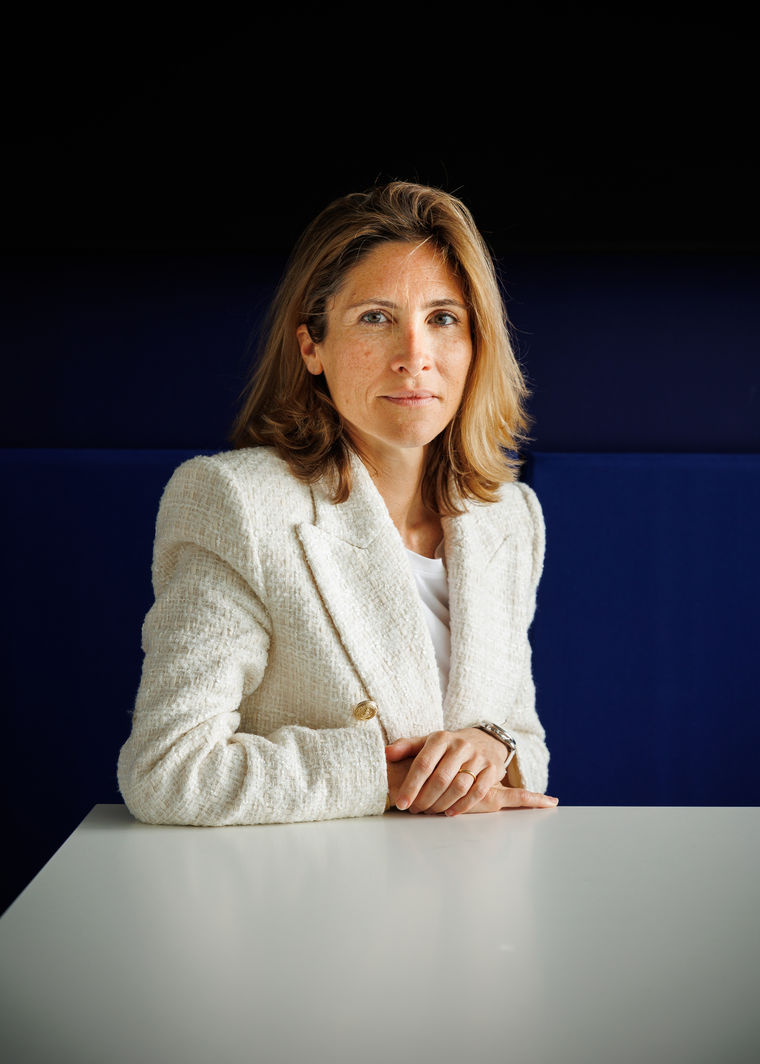
Julia de Funès © Laurent Villeret for Philonomist
But is this really progress?
C. C.: This is huge progress for the consumer. For example, many people criticise Amazon, but three-quarters of people are customers! That said, there are methods of exercising these professions. In France, so far we continue to consider that since there are platforms and people willing to work for them, and since the system creates employment, it should be preserved, in accordance with the precautions provided by the country’s labour legislation. In other countries, such as the Netherlands or Spain, the legislator has gone a step further, considering that it was even more necessary to regulate a system that fosters precariousness and to return to a model of salaried employment instead of this so-called “cheap work”. This is leading some companies to leave these countries and therefore no longer provide the service consumers want. It’s a philosophical debate on the relationship to work, and also a societal debate. Say, a student chooses to work for an online platform – they’re not contributing to their retirement, but that’s the least of their worries at the start of their working life. Is this irresponsible on the part of his employer? Or on the part of the student?
J. F.: New technologies and American companies are generally seen as threats to small French companies. But what neighbourhood bookseller, what craftsperson, and what small business today doesn’t want to be on Amazon, for example? Many tell me how much Amazon has saved them! If we oppose these two worlds, it’s because we’re still ruminating in that right-left ideology of which our country is so fond.
It’s the same with environmentalism. Thinking about it in opposition to the economy leads directly to degrowth! Linking the two – bearing in mind that the economy without ecology is debatable, but that ecology without economy is powerless – seems to me less dogmatic, more pragmatic, and more promising. Our country would for once stand to gain from becoming more American on this point, by valuing success, progress, creation, and by ceasing to systematically make capitalism a taboo and the source of all our ills. Once again, we can think about social progress, environmental concern, and technological innovations together. We still need to free ourselves of the dogmas of politicians.
‘Understanding the why of a technology, seeing the benefits it brings, is what makes you want to appropriate it very quickly’
—Christophe Catoir
How can employers support employees through what they call “digital transformation”, which forces organisations to adapt jobs and tasks to a new environment?
C. C.: We tend to focus too much on the how. How can we appropriate this new technology? How can we organise ourselves in a new way of working? We forget the why, which gives people the motivation to learn by themselves. Understanding the why of a technology, seeing the benefits it brings, is what makes you want to appropriate it very quickly – because you can see its purpose. The role of management is always to repeat “why” we’re doing this or that, and to come to technology or new modes of organisation as a mere means to get there more efficiently, with more value and engagement.
The second element is that in recent years, we have tended to want to format everything, to make everything more predictable. But since each individual is different, what framework should be adopted in order to achieve the collective objective? The challenge is to succeed in achieving a convergence of action, but to allow everyone to express themselves according to their degree of maturity, of expertise, and their dependence on other positions, since, in business, interdependencies have become prominent.
In many professions, especially in service activities, you hire someone because they have a spark in their eyes. You want to work with them because they’re convinced, they’re motivating to be around. But there has to be consistency. They say healthcare jobs have meaning, but if people then spend their days doing paperwork, they’ll hate what they’re doing. The worst thing is to oversell a trade that turns out to be disappointing. After hope comes dissatisfaction, and your energy gauge drops day by day.
J. F.: What makes it possible to value the individual is to make them active, autonomous, so that they feel like an actor, the author of their professional life, and not simply a good little soldier performing their duties. But very often, in business, we gesticulate more than we act. To feel active, we must be able to take risks, answer the question of the meaning of what we’re doing, and evolve in a climate of trust in order to take action. Where some are worried about AI competing with human intelligence, I’m more worried about human intelligence, which soon becomes artificialised when it cannot meet these three conditions.
Let’s take an example. Twice a month, for five years, I went to the same company, where the welcoming process simply involved handing over your identity card in exchange for the traditional fluorescent lanyard badge. One day, I forgot my identity card. I dared to ask the receptionist – who knows me, since I’ve been there a number of times – if I could still get the badge. The irrevocable sentence fell: “The procedure is the procedure!” It’s a major managerial mistake to hire people today to make them say, “That’s not the process”. AI is able to identify me thanks to facial recognition and know everything about my presence in the company. Humans are therefore being reduced to less than machines...
In short, I think that helping employees become subjects, with autonomy, and not just executors of process, is key to having relationships that are motivating, empowering, and humanising. This is rewarding for the individual, but it’s also profitable for the company, because nothing is more efficient, stimulating, and motivating than feeling active. As Montaigne says, “We were born to act.”
Picture © Laurent Villeret for Philonomist
