


started her career at France’s Ministry of the Economy before going on to become the CEO of Paris’ public transport provider, RATP, from 2017 to 2022. She’s a graduate of France’s prestigious National School of Administration (ENA), and has also worked for Air France, Eutelsat, and Rexel. She stepped down from her position as CEO of RATP in September 2022 for personal reasons.
Picture © Xavier Schwebel for Philonomist

is a geographer, professor at the Lyon Urban School, and member of the think tank, “Environment, cities, society”. His work focuses on global urbanisation processes and their social and environmental impacts, on which he has published a number of articles and academic books in French.
Picture © Xavier Schwebel for Philonomist

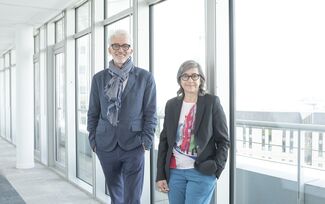
Data, AI, hydrogen, electricity: when it comes to reinventing transport, innovations are in no short supply. And in an increasingly urbanised world, in the grip of a major environmental crisis, mobility will have to undergo transformation. So what are the challenges of tomorrow’s mobility? Catherine Guillouard, former CEO of the Parisian public transport provider RATP, and Michel Lussault, geographer, exchange their thoughts on the subject.
In the era of the green transition, the question of mobility is increasingly present in debates. Our current model isn’t sustainable – that much, we know. And to move away from it will require technology, namely the invention of cleaner vehicles and the development of a public transport system that meets everyone’s needs. These developments will also need to be thought out in accordance with their geographical setting, on which they will inevitably have an impact.
To untangle the complex issues at stake, we brought together a geographer specialised in these urban questions and a business leader directly concerned by them: Michel Lussault, founder of the Urban school in Lyon, who has worked extensively on the analysis of urbanisation processes and their social and environmental impact; and Catherine Guillouard, whom he met just before she stepped down from her position as CEO of the RATP, the public transport provider for the Paris region. Their exchange led to a flurry of original ideas and proposals. How do non-urbanised spaces experience the effects of urbanisation? How and why should we contain cities? Why don’t we get property developers to finance public transport? How could AI be used to make sure trains run on time? The discussion makes for an inspiring and timely read.
Interview by Anne-Sophie Moreau.
How is mobility a crucial issue for humanity?
Michel Lussault: Among the interesting characteristics of the human species, there is undoubtedly its long-standing appetite for mobility. The way humans populated the planet as early as the Palaeolithic era already had something to do with their desire for mobility, which archaeologists and prehistorians have shown was never exclusively coupled with an immediate functional need. That’s the fascinating thing about mobility: it can never be thought of simply as a function. In the contemporary period, this is illustrated by the desire of certain actors (political, cultural, social, etc) to have it recognised as a fundamental human right; not as a conditional right (“I have the right to move around if I am asked to work somewhere”), but as an individual rightful claim to mobility, for whatever project it might be.
Catherine Guillouard: Mobility is a condition of freedom. We saw and felt it during the pandemic: all the front line workers were able to go to work because the public service that we were had continued to operate. At the RATP, we set up twenty bus lines dedicated to hospital workers during the first lockdown, to allow them to move around, including at night.
‘Mobility is everything that allows us to move; it cannot be reduced to the existence of a vehicle’
—Michel Lussault
Has the Covid crisis changed our vision of mobility?
ML: Covid has shown us that as soon as we close down airports, train stations, and major connecting hubs, where there’s an exchange of goods and people, not only does the world stop, but the urban world loses one of its conditions of possibility. For 80 years, technological progress in a broad sense – not just the technology of modes of transport, but the technology of the whole system – has allowed individuals to move around more easily. Because mobility is everything that allows us to move; it cannot be reduced to the existence of a vehicle.
This is why I prefer to speak of mobility and logistics – which I define as the field of techniques and procedures necessary for a person to go on a journey – than of mobility alone. If, at the RATP, we change our bus fleet, the entire logistics system has to be reconsidered. However, without the logistics of people, materials, and data that we know today, the world would be a very different place. For several decades, there has been a kind of coupling between the aspiration for mobility, technological evolution, and the global urbanisation which has shaped the mobile and connected world we live in, the strength and vulnerability of which came to light during the pandemic.
CG: We took advantage of this crisis to collectively question our purpose, which was revealed in March 2021 and which we defined as “committing each day to a better quality of city” [a play on the words, “quality of city” and “quality of life”]. Yes, we’re a public transport operator, but we also manage infrastructure, we build metro lines and maintain them. We’re also building real pieces of the city, by building crèches or housing above bus centres.
Today, the RATP is a fabulous gauge of how things are going following the pandemic. During the week, attendance on our main suburban lines (RER) stands at 86% of its pre-pandemic level. On weekends, the metro is at 90-95%; on weekdays, it’s at 85%. A new societal pattern is emerging, with a new relationship to remote work and leisure. What we see are people who, through remote work, have taken on totally different habits, and they’re staying home to work more. The effects of peak hours have smoothed out: companies no longer expect their employees to be at their desks between 8:30 am and 9 am.
During the crisis, we also saw a very strong increase in the logistics and e-commerce component. We anticipated this: to make the best use of our assets, we brought in logisticians from Amazon and other delivery services, to organise small logistics platforms inside our bus centres and be able to deliver to the city centre using electric transportation alone. All with contracts and clauses that respect the social conditions of employees, of course.
‘As soon as we talk about mobility, we talk about human life in society, and therefore about things that are extra-technological’
—Michel Lussault
ML: From what you’re saying, we can clearly see that in terms of mobility, we shouldn’t just consider technology, even if these are fundamental. Because when we talk about mobility, we’re talking about human life in society, and therefore about things that are extra-technological. Mobility is a set of activities, resources, and practices; and even people’s imagination and culture, allowing the interplay of relationships and connections which lie at the heart of today’s world. It’s no coincidence that the major mobility operators in the world – and there is no counterexample – have all become major cross-functional urban operators.
This is also true of large freight logistics groups which are major “urban planners”, in the sense that they make a powerful contribution to the establishment of spaces that are emblematic of contemporary urban life. We could easily show how a company that reigns over logistics like Amazon is also a company that does urbanisation. In short, we must always associate an analysis of mobility-related facts, with all their urban dimensions, with an examination of logistical facts.
What are the issues related to intense urbanisation today?
ML: Technological innovations have enabled faster mobility, but above all on a larger geographical scale, because each time we gain speed, we gain space. Mobility is a spatio-temporal phenomenon: if you increase your average speed, you gain in traversable space per unit of time. This was the origin of suburbanisation.
I am of the family of researchers who consider what we call “the planetary organisation”: for us, urbanisation has spread to all spaces and all societies, even those which apparently aren’t urbanised. If you’re in what seems to be a rural area, not formally urbanised, but you’re dependent on your car to access goods and services, and connected to the telecommunications network which provides a certain number of services and activities, you’re part of the planetary urbanisation process. Everything is actually connected in a global system, what I call the “planetary urban system”, in which we find fairly comparable forms of life.
‘The city must be contained, because horizontality is very expensive, both to install and to maintain’
—Catherine Guillouard
CG: We have moved to extremely high rates of urbanisation. Today, 70% of spaces are urbanised, with a hundred cities that will have more than 5 million inhabitants by 2030. It will be a major challenge to live in these places whilst preserving the environment and quality of life as much as possible. The city must be contained, because horizontality is very expensive, both to install and to maintain. And we can hardly say the urban sprawl is fantastic.
At RATP, our objective is to contribute towards a reasonable and reasoned urbanisation. We’re very much committed to aspects of social and environmental responsibility. And we’re strong supporters of verticalisation: we use the base of our industrial assets to build up, to optimise spaces against urban sprawl. We refuse to reduce our vision to transport, even if it’s obviously our core business.
What types of transport should be favoured or developed to curb global warming?
ML: When we analyse mobility technology, we’re too often obsessed with vehicle technology. However, it’s not so much the intrinsic performance of vehicles that has been central in recent years, but rather their compatibility with economic issues, with social aspirations, and, more recently, with the challenges of decarbonisation.
CG: The use of public space is an important topic. To give you an example, if the 1,700 people currently using our RER suburban trains decided to go back to using the car, we would have – given that in the Paris area there’s about one car for every 1.2 motorists – 1,400 cars more in circulation, just for one train! It would be a disaster, in terms of pollution, but also for the public space. Mass public transport mobility is very economical from this point of view. Every day, 1.4 million travellers take the RER A line alone. And it’s in the city that this fight for public space plays out.
‘The great strength of public transport is that it could save everything: space, funding, funding, and the attention span of travellers’
—Michel Lussault
ML: We could add that the great strength of public transport is that it could save everything: space (road and vehicles use too much of it), resources, funding per kilometre travelled, the attention span of travellers (when they’re relieved of the need to drive, passengers can focus on other activities, such as reading, listening, resting, etc). However, a lot of work remains to be done, to fulfil these promises. If we want urban societies to face the challenges of global change (heat waves, pressure on resources, the restoration of hydrosystems and ecosystems, etc), we will need social technologies that will allow us to further intensify public transport whilst improving its quality of life and peacefulness.
CG: Public transport is a major factor of decarbonisation. At the RATP, we have a very important objective, which is to reduce our greenhouse gas emissions by 50% between 2015 and 2025. Three-quarters of our greenhouse gases come from buses: so in the Paris region we’re converting our 4,700 buses and 25 bus centres to clean energy. Last year, we made 600 clean buses, this year 500. All without interrupting our operations.
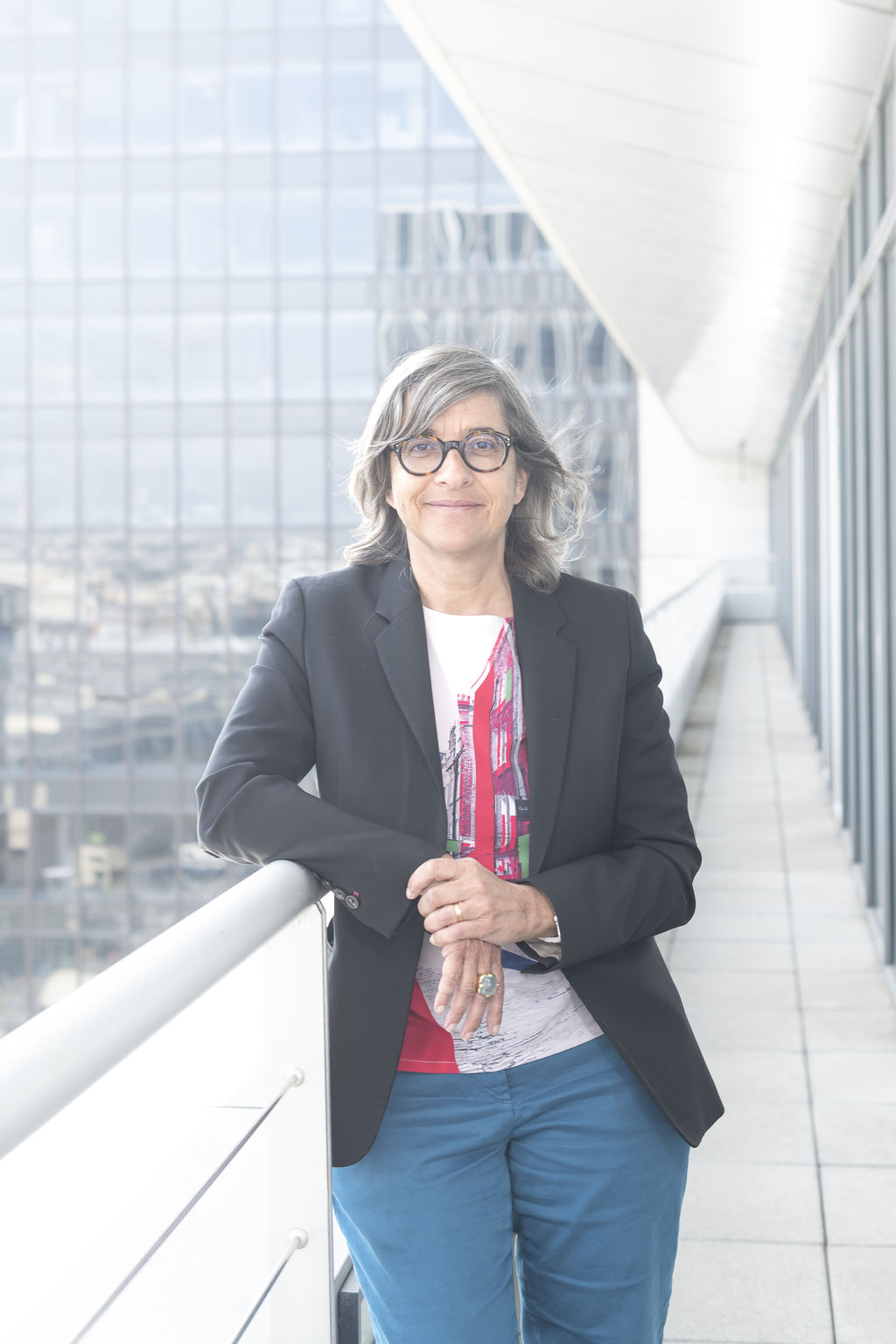
Catherine Guillouard © Xavier Schwebel for Philonomist
What about innovations like hydrogen, which some say are a false solution?
CG: We make hydrogen buses. But I don’t think the technology is mature yet. When I arrived in 2017, I discovered that for each bus centre that was converted to electric or biogas, the regulatory requirements were different. The same goes for hydrogen. Grey hydrogen, which is generated using fossil fuels, is of much less interest than green hydrogen, which is produced from electricity of renewable origin through the electrolysis of water. I strongly believe that hydrogen can be an answer, but only beyond the 2030s, since the infrastructures still have to be built.
It’s the same problem for electric cars. Today, I challenge you to drive across France by electric car without running into any difficulties (you will have to look for charging points, etc). The lack of infrastructure is an absolute priority for the next 10 years, both for hydrogen and for electricity.
‘The metro, bus, and suburban trains are the last places of social diversity’
—Catherine Guillouard
Is there a risk of moving towards a system where the most privileged will drive electric cars, while the working classes will be piled up in public transport ?
CG: You’re right to point to the subject of the electric car. This mode of transport is very expensive. How will low-income households manage? Our niche is public transit. The metro, bus, and suburban trains are the last places of social diversity. And note that we haven’t observed post-Covid “social segregation”. This inclusion is part of the mission of public transport, which lives up to the name “transport in common” [French for “public transport”]. There has been a lot of help from the city of Paris and the region, to encourage people to use our services.
This also poses the problem of funding. Today, customers still cover little of the overall cost. In relation to the investments made, travellers in the Parisian region pay around 30% – compared to 40 or even 50% in major foreign cities such as Madrid or London. However, as part of its contract with the Paris region, the RATP aims to invest 8.4 billion between 2021 and 2024. And it has already begun: we’re extending the train lines, renovating the rolling stock... But all this costs a lot of money, and the system must provide for the maintenance of these infrastructures.
Today, we’re in a financial dead-end: the region has been turning to the state for three years to complete the financing. We will have to expand the funding toolbox, otherwise we will jeopardise the entire public transport system, which is nevertheless a major vector of the low carbon strategy. Mobility is a collective work.
‘My conviction is that funding must be extended, particularly to real estate development’
—Catherine Guillouard
Where can you find funding for public transport?
CG: My belief is that funding should be extended, particularly to real estate development. Between the moment when we decided to build the extension of line 14 and the moment when it saw the light of day, real estate prices increased by 54% in Saint-Ouen [the area of Paris at the end of the new line]. But not a euro has been captured by the system and reinjected into the transport system. When we look at the positive externalities created by public transport infrastructures and the low return that we reinject into their financing, we say to ourselves that this is absurd, from an economic point of view. Hong Kong’s public transport operator derives two-thirds of its gross operating profits from property development. It’s a large real estate developer, which makes profit and reinjects it by developing public transport.
ML: This is a real topic. In many countries, the positive externalities of public investments are captured by companies which, in return, often pass on the negative externalities of their own investments to the state. It’s a formal defect of the initial conception of urban development which has reigned supreme, particularly in the last fifty years, with what could be called the dominant imaginations of the metropolis, or “world city”. But this global city of contemporary capitalism only exists because of the positive externalities of public investments, and the public management of the negative commons. Public authorities and civil societies must therefore regain control.
What role will new forms of mobility play in the journeys of the future?
CG: We have a holistic vision of mobility: our role is not only to provide mass public transport, but also to offer new mobility to move from one point to another, taking into account the last kilometre. RATP currently has a portfolio of thirteen forms of mobility, ranging from maritime shuttles to buses, including five new mobility solutions such as shared car parks, car sharing, carpooling, etc, and apps: on our Bonjour RATP app, you can now book a trip that includes bicycle or car rental.
‘Work on the connection and articulation of different modes of mobility has allowed us to make enormous progress in the field of urban mobility over the past thirty years’
—Michel Lussault
ML: Other technologies are replacing the sole technologies of performance and speed. Work on the connection and articulation of different modes of mobility has allowed us to make enormous progress in the field of urban mobility over the past thirty years. The longitudinal chain of mobility begins with the lower intensity technology that is walking, which is fed back into this continuum through, for example, digital applications.
CG: So much so that walking time is now integrated into the applications!
ML: What is spectacular for a geographer like me are the “digital neo-geographies”, that is to say the way in which digital technology and applications have upset our relationship to space. These extremely sophisticated technologies which make it possible to identify one’s position in real time, to establish routes, etc, have given the most elementary technique – walking – a central role. Since it’s always more or less around walking that we build the rest. What is essential for a technologist is not to aim for the most efficient bus, in absolute terms, but to think about how to create articulations – which explains why there can be no mobility technology today without data, algorithms, and a computing capacity. It has become both the power element of the logistics system, but also its fragility, since it also creates strong dependencies on technological paths.
‘An efficient mobility system is a system capable of making connections between different types of mobility’
—Catherine Guillouard
CG: We’re working on intermodality but also on multimodality. An efficient mobility system is a system that is able to make connections between different types of mobility. What’s the point of having a bus completely disconnected from the arrival times of the RER?
How can AI and data help improve mobility?
CG: Technology must improve operational efficiency and be developed to provide services to citizens. We already have a very sophisticated system, and technologies will allow us to make more and more progress. While on the RER, many breakdowns are linked to the gates, so we set up an AI program that detects problems upstream. This resulted in a 30% drop in breakdowns at the doors of our RERs.
In addition, the performance of a transport operator today requires data. Here’s an example: recently, a slope collapsed as a result of bad weather. We therefore had to draw up a plan for dealing with these crises, so we inserted a whole technical component for the monitoring of our infrastructures using connected objects.
‘We’re seeing the start of a hidden war over data, between public and private actors’
—Catherine Guillouard
My great obsession is how to maintain the ability to use data in the most intelligent way possible to improve the operational efficiency of our network and operations. This is important because we’re seeing the start of a hidden war over data, between public and private actors. When you talk about service network mobility, you have to be sure of the reciprocity of data exchanges. The RATP is the second open data operator in France: every month, more than a billion pieces of data leave the company, and they’re used by private operators such as Google. The reverse should also be true. But instead, the system has seriously drifted towards an asymmetry: it’s easier for a private operator to come and use the open data of public operators than the other way round.
This is something that France’s law on mobility of December 2019 has started to regulate, but the implementing decrees haven’t all been released, and this is a huge challenge for us. We have no problem sharing our data for the collective improvement of the tools which will then have an impact on the quality of the service offered; on the other hand, we mustn’t be angelic: operators must also be able to access and sell the same digital services that are offered by the legislator. It would be totally absurd for transport operators like the RATP to go down the value chain and become mere traction operators. This is the danger we’re trying to avoid by being a sovereign operator: sovereign through its operational power, but also over its data.
ML: I do think that data is central, and that it’s sometimes necessary to get away from an over-simplified discourse on data, whether allegorical or hypercritical, because social realities are much more complex. This could allow a sovereign mobility company to succeed in doing two things that have seemed irreconcilable for too long: to master its operational production system, whilst being perfectly aware of the aspirations and practices of each individual. Data is a gateway to a qualitative understanding of mobility.
CG: Through data, we try to have a very detailed analysis of the urban environment in which we operate. In Île-de-France, for example, we have 4,700 buses, 335 bus lines, and a lot of complicated subjects around the use of public space, with construction and repair, work, traffic, etc. This is why we have developed a partnership with the Massachusetts Institute of Technology (MIT) to organise sidewalks. We want to understand how Gordian knots are formed: a roundabout might be obstructed by road works, for example. Before the arrival of the internet, you would just jump in your vehicle and drive… Today, we need to understand what’s going on in a more subtle way, to achieve a certain level of performance.
ML: It’s certainly a great opportunity to be able to connect the ethnography of practices to these data. The only reservation I have on this is that the power given by big data offers a granulometry of each piece of data that can go all the way down to the individual scale… This aspect poses enormous ethical problems.
‘If techno-solutionism is the idea that technology is autonomous, then I’m not a techno-solutionist’
—Michel Lussault
Should we be wary of “technological solutionism”, i.e. the idea that all problems will be solved by technology?
ML: What is decisive is not having a naive techno-solutionist aim. If technology imposes solutions on humans that they don’t want, I’m not interested in it. What we really need is technological compounds, which range from elementary technologies – walking – to the most sophisticated technologies – big data; from hydrogen to the use of other cruder and more sobre technologies; from classic door mechanics to sensors. Technology is nothing if it’s not integrated into a system driven by the capacity for social problematisation, political will, and a concern for ethics and justice. If techno-solutionism is the idea that technology is autonomous, then I am not a techno-solutionist.
CG: A company doesn’t float above the ground – it belongs to an ecosystem. Part of the improvement in performance is endogenous to the company: it’s our own processes, what you called the control of the production system… But there are more and more exogenous subjects, such as the accumulation of multimodality in the same public space, which can sometimes create danger zones. We need to be able to better understand this exogenous character in order to unlock this or that place. That’s what we’re trying to do with MIT: come up with ideas for improvements that aren’t just centred on the company’s inner functioning, but also its ecosystem. The power of data is central here, it allows us to rationalise the discussions we have with outside partners, because a more quantitative discussion allows us to provide proof.
ML: As you said, data allows us to take the exogenous into account: welcome to the Anthropocene world, or to the world of global change! Epistemologically, we can no longer think of realities as if they were a whole isolated from the rest. When we observe any reality whatsoever, we must start by first acknowledging that we will have to take into account the exogenous, that which is exterior to it; and that it could even be this exogenous element which, in its relations within what we think we can control, will largely guide what we can say and do in this functional system. To a certain extent, digital technologies are technologies that allow us to make this journey from the exogenous to the endogenous and vice versa.
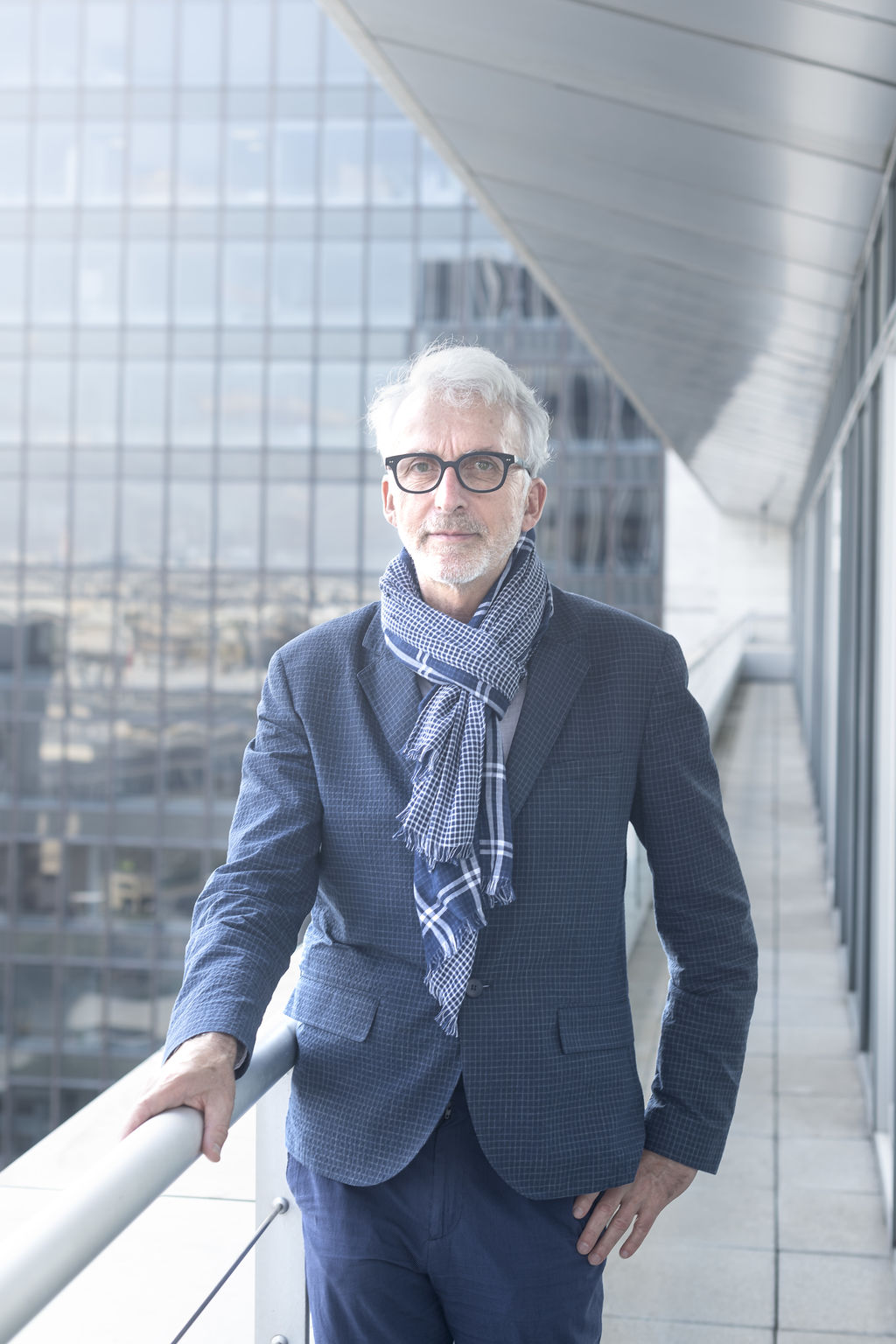
Michel Lussault © Xavier Schwebel for Philonomist
Many voices are calling for a drastic reduction in travel as the only way to mitigate global warming and respond to the lack of energy resources. Do you believe in the need for a general “demobility”?
ML: As an empirical researcher, I see an urban world with 10 billion inhabitants coming, which must always be taken into account. We’re not going to ask people to become pedestrians living in their home villages again: that would be unsustainable. We will always need urban systems. However, urban organisations don’t function without mobility. I’m therefore for the maintenance of mobility, and for there to be no a priori limitations on mobility.
But certain forms of mobility must be prioritised over others. I’m not talking about de-mobilisation, but about what I would call an alter-mobility. We will have to think qualitatively about the different forms of mobility, choose which ones we should gamble on, for the right to mobility to be recognised, and ask ourselves which ones are really essential. Low-cost tourist mobility may not be essential. The overmobility of certain social groups – which today we call the hyper-rich – isn’t essential either.
‘If automobiles become less present, we will realise that our urban spaces will unfold in a completely different way’
—Michel Lussault
Similarly, it must be recognised that the urban future in a period of global change should be a future of “disautomobilisation”: we must overcome our individual and collective dependence on the automobile. This obviously poses enormous political problems, but it opens up considerable prospects. If the automobile becomes less present, we will realise that our urban spaces will unfold in a completely different way. We saw this during the pandemic: when cars stopped, we rediscovered the extent to which they occupied spaces that we could use quite differently.
CG: As president of the RATP group, I’m convinced that if any company is key to the success of the low carbon strategy, it’s us. We’re able to move millions of people in such a way as to avoid an excessive hold on public space, and in better conditions. Our metros, RER, and trams do not pollute, since they’re electric. Once the buses have been converted, we will have a superb mobility tool with a very low greenhouse gas emission rate, in proportion to the millions of people we will be moving.
How can we maintain access to mobility for everyone, in a world where resources are limited?
ML: Some of my colleagues today are proposing systems of mobility rights that are socially differentiated, and I find the prospects interesting. It must be studied seriously. You said it earlier, when the RATP networks were operating during the pandemic, it was above all the fragile but essential social groups – the front line workers – who had to get around. We need to help them to secure a right to mobility which might be less restrained than that of someone who can afford a private jet. We need to approach this question in a qualitative way.
I think the future belongs to collective, public transportation systems which will allow for an approach that takes into account the exogenous – that is to say, systems which start from the mobility needs of the individual and move towards a general reflection on the urban organisation on the whole. We need to ask how we can meet people’s needs in an urban system which now has very strong economic, social, and environmental constraints. This will call for an ability to define new political avenues and actors involved in order to reach decisions that question our habits and daily routines.
CG: Public transport systems are magical in that they were born in this ecosystem, and know how to take it into account – unlike automobile travel, in which individualism reigns (which stands true for heat engine vehicles or electric one). Their open nature – open to their ecosystem, inclusive, social, environmental – and mastery of technology and travel routes mean that public transport ticks all the boxes. This is why we need to develop it, and why the question of its funding is absolutely crucial.
Photo © Xavier Schwebel for Philonomist
