

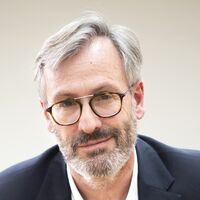
has been the president of Accenture France and Benelux since 2018. He also sits on Accenture’s Global Management Committee and as well as the International Advisory Board of the French business school ESSEC.
Picture © Marie Genel pour Philonomist

is a paleoanthropologist specialising in human evolution, to which he has dedicated a number of books in French.
Picture © Marie Genel pour Philonomist
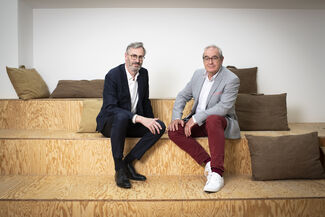
Autonomous cars, Chat GPT, metaverses: in recent years, major technological innovations seem to have multiplied. It’s hard to imagine what the society of tomorrow will look like, but one thing is certain: it will be shaped by technological development. How is technology changing our lives, and more generally, our species? Pascal Picq, a paleoanthropologist, and Olivier Girard, president of Accenture France and Benelux, explore the question.
Whether we realise it or not, technological progress is changing our lives. And this has always been the case: the mastery of fire, the development of agriculture, the invention of the combustion engine and then that of the internet have all enabled human life to reorganise around these technologies. Today, the generalisation of remote work is already transforming our society and our lifestyles. AI and the metaverse, which are still in their infancy, promise even greater upheavals.
To discuss the impact of technologies on our lives, we brought together two people with complementary views: Pascal Picq, a renowned paleoanthropologist who studies the way humans have evolved from their beginnings to our digital age; and Olivier Girard, president of Accenture France and Benelux, which supports French companies and institutions in their transformations, and whose technological expertise is widely recognised. Together, they outline what Pascal Picq describes as a real “anthropological revolution”, driven by the latest innovations in the field of intelligent machines and digital technologies.
Interview by Anne-Sophie Moreau.
How are technologies changing our lives?
Olivier Girard: To analyse the impact of technologies and the scientific revolution on humanity, I’m interested in three periods of history: the arrival of agriculture, the industrial revolution, and the current era. Each of these revolutions has upset our relationship to time and space and, consequently, our relationship to ourselves and to the world. With the agricultural revolution, we stopped moving with the seasons. The industrial revolution is the time of acceleration: this is when the word “productivity” was invented, which implies thinking about efficiency in terms of a relationship to time. Today, technologies are pushing us to consider the dimension of real time, instantaneity, with the complexity that this implies. The same goes for our relationship to space: the agricultural revolution has hastened sedentarisation. The industrial revolution allowed the growth of the city. We have now entered a multidimensional framework, with a continuum between the physical world and virtual space which hybridise more and more naturally.
Pascal Picq: The main characteristic of human life, namely the homo species, which appeared in Africa two million years ago, is that we’re able to adapt under the constraints of the environment – like other species – but also by inventing new modes of production and life. Our morphological, physiological, and cognitive capacities are very plastic. We’re also capable of transforming the world through technology. However, tools and machines don’t just improve our basic human skills (in terms of speed, precision, efficiency, etc) – they also transform our biology. We boomers have gained twenty-five years of life expectancy without changing our genetic makeup, thanks to medicine, culture, education, social progress, etc.
The human lineage is characterised by what I call “the second coevolution” or “biocultural coevolution”. Every great technological innovation, or “general purpose technology”, produces “revolutions” that affect all aspects of our lives. Fire two million years ago, agriculture ten thousand years ago, the steam engine two hundred and fifty years ago, electricity and the internal combustion engine one hundred and fifty years ago, the chemistry of synthesis and computing sixty years ago, and now digital technology: these have all had, are having, or will have consequences on the means of production and work, but also demographic, societal, political and philosophical consequences.
These changes don’t offer an overall improvement, but a new compromise in which the advantages prevail over the disadvantages. Joseph Schumpeter speaks of “creative destruction”: any adaptation has a negative cost for part of the population. This is what we have seen everywhere for more than a decade, especially in rich countries. And our brain tends to see the immediate disadvantages rather than the expected advantages.
How does a disruptive technology appear?
P.P.: We tend to explain the appearance of technologies by solutionism: we believe that they were invented to solve problems. Our ancestors are said to have invented cooking, for example, because they were tired of eating raw food... But it didn’t happen that way. There is a double articulation between the appearance of inventions – which can be intentional and dedicated to a problem or project (solutionism) or attributed to processes (like serendipity or exaptations) – and, secondly, their selection and then their development in society.
‘The great mistake of the West after the fall of the Berlin Wall was to persist in believing that humanity follows its inventions and that our model would become universal’
—Pascal Picq
O.G.: You only find the true use of an invention later. A light bulb looks like an upgraded candle – but it isn’t! It’s only later that electricity finds an increasing diversity of applications. The same with the computer, which was first seen as a computing power before we developed new uses. Or the smartphone, which now encompasses all our activities.
P.P.: Another aspect is that great innovations never appear on their own, but independently and under different profiles in different parts of the world. When I was a student, there was talk of the theory of “diffusionism”: it was believed that the West was the home of all inventions and that they then spread elsewhere. But this isn’t the case. Agriculture appeared in at least eight different centres between 8,000 and 3,000 BC. More recently, in the last millennium (what some call the “axial age”), the great philosophical and religious systems emerged. And today, we’re witnessing a similar phenomenon with the digital revolution: Americans aren’t like Europeans, who aren’t like the Chinese, etc. The great mistake of the West after the fall of the Berlin Wall was to persist in believing that humanity follows its inventions and that our model would become universal. This was the illusion of a happy globalisation!
Does technological development necessarily lead to political progress, moving us towards more democracy?
O.G.: In the preface to Of Democracy in America [1835], Alexis de Tocqueville explains how democracy inevitably imposes itself, helped among other things by scientific progress. He shows, for example, how scientific progress in the army has contributed to pushing back what was considered a privilege: before, only a noble could fight because you had to have learned how to use weapons. But then, technical progress allowed other people to join the army. Such progress therefore contributes to the “gradual development of equality”, to use Tocqueville’s words. The role of technology in the dissemination of knowledge is another case of this, with the printing press and the advent of the internet.
P.P.: You have to be aware of historical, cultural, and anthropological constraints. Here we touch on the question of freedom and the ability to improve human beings. After China joined the WTO, futurists rejoiced at the idea of the emergence of middle classes like in Western countries after the Second World War. But where are these middle classes in the BRICS nations [Brazil, Russia, India, China, South Africa]? There has never been so much bipolarity between the very rich and the poorest in these countries. As for democracies, they’re suffering great setbacks.
‘It would be very presumptuous to assume that more technology necessarily leads to more democracy’
—Olivier Girard
O.G.: We haven’t always believed in a happy globalisation. After Fukuyama, who announced the “end of history” and the triumph of democracy, Samuel Huntington published Clash of Civilizations [1996], which unfortunately defended a more lucid point of view…
Coming back to technology, I think it would be very presumptuous to assume that more technology necessarily leads to more democracy. Technology is a tool, a vector. But the question remains: “What do we want and what can we do with it?” The Arab Spring revolts showed us that it can facilitate protest, by revealing what certain powers wish to hide, and accelerate mobilisations. But technology is also used as a tool of control, in particular by authoritarian regimes. A sort of perfect panopticon, as Jeremy Bentham imagined it in the 18th century, digitally and across society. We have to accept this apparent contradiction. For democracy, nothing is certain, but the best is always possible.
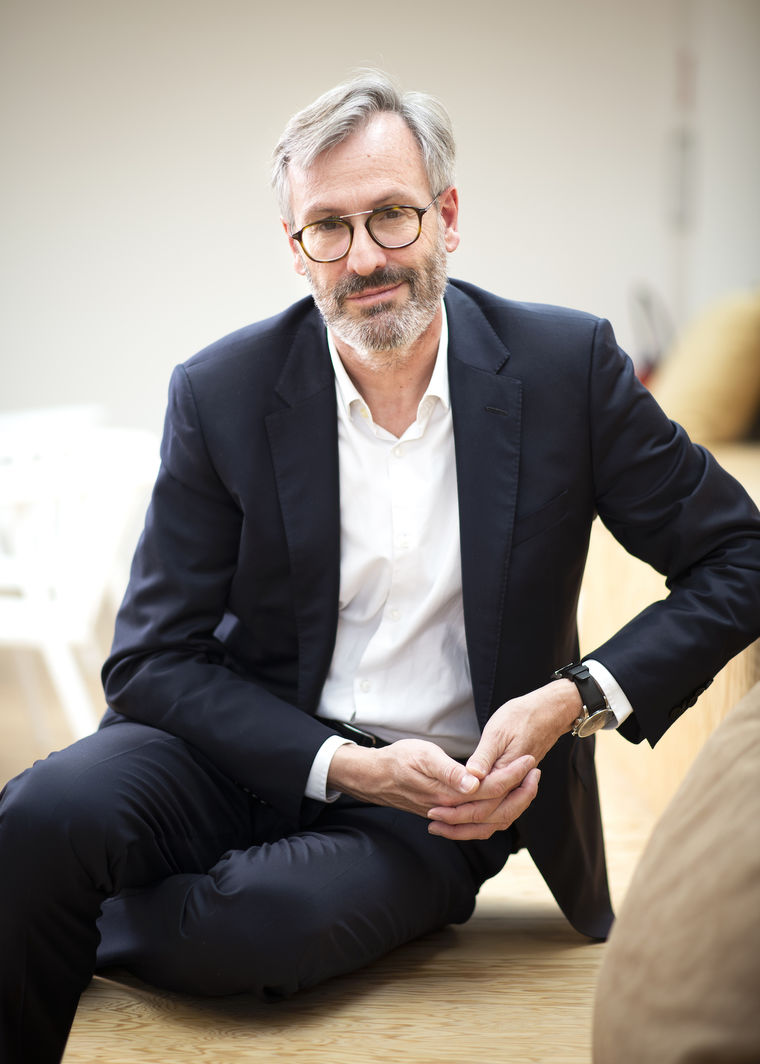
Olivier Girard © Marie Genel for Philonomist
Humanity has always produced technological innovation: what makes today’s era so special? Are we living in a time of deep rupture?
P.P.: There have been two major paradigm shifts. From the first flints to the first age of machines, tools and machines made human movements more efficient, quick, and precise. With the industrial revolution came the time of “machine as labour” which requires learning from users. This logic leads to what is called “human automation”, the idea being to ensure that humans aren’t hindering the performance of the machines. Technical actions are imposed on users, with a Taylorian and behaviourist conditioning that is traumatic for people’s bodies and brains. The same was true for the products put on the market and their uses: people had to learn new techniques, like driving cars. Of course, they already had to learn to ride a horse, but without having to change their environment, and without regulatory constraints. Cars are a different matter.
The second major paradigm shift came in 2007, when Steve Jobs presented the first iPhones to the world, heralding the advent of smartphones. He said he was going to change the world. Because he put a machine in our hands, and more importantly, technologies that encourage us to invent other uses: applications. It started with computers, general-purpose machines intended for more and more uses, even those not thought out by their inventors. The phenomenon of startups comes from there: while large investments were needed for the industrial revolutions, smartphones and other connected devices allowed people to create economic activities by becoming the owner of one’s own means of production. Digital technology and its tools led us into the world of the “brain as work”, with a whole procession of cognitive transformations. In the mechanical and analog world of my youth, all actions followed a constrained sequence of steps. Today, we can achieve the same goal by various paths, like machines, software, and algorithms.
‘The arrival of the smartphone is a false revolution: the real revolution is still ahead of us’
—Olivier Girard
O.G.: The arrival of the smartphone is a false revolution: the real revolution is still ahead of us. The first era of digital technology is the revolution of the customer experience: that of access to a product or service. Amazon reduced the act of consuming to its simplest expression: a mere click between the consumer and the product. Everything is simplified and dematerialised. The next revolution will be one that combines the expansion of the Internet of Things (IoT) and edge computing [an alternative to cloud computing, which allows data to be processed close to its source, without going through data centres] to make products intelligent, service-oriented, personalised, in a way that uses real time. The electric car is an evolution of motorisation; the autonomous car, a complete revolution in the industry. We’re living in a moment of secular transformation, as we did in the time of the discovery of electricity or the combustion engine. Nothing will be the same, even if we still have a hard time imagining it.
Will the metaverse change our lives?
O.G.: Metaverses carry two revolutions in one. They upset our relationship to time and space. Time is very fragmented on social media: we have several conversations at the same time on WhatsApp. In the metaverse, our avatars are talking in the same space-time. It looks like an attempt to restore a space close to a physical space, without the constraints of the latter. It will also make it possible to go further in remote work, by making it accessible to some blue-collar workers too. The other revolution is the one that will allow us to have a unique, secure digital identity that can move from one site to another, where today we only have one identity per site.
‘Soon we will all have digital duplicates of all our personal data’
—Pascal Picq
P.P.: Metaverses are the expression of a digital galaxy that is only getting bigger. They’re the logical convergence between social media, games, and virtual reality tools, digital twins and blockchain, and they engulf more and more personal, social, and economic activities. After uberisation, now we’re entering the time of “gamification”! I see a paradox there. Algorithms know us better than ourselves (suggestions for product choices on Amazon or Netflix movies pale in comparison with what already exists). Soon we will all have digital duplicates of all our personal data. Chinese digital companies draw up very elaborate profiles of their customers, for example. But these digital doubles aren’t avatars, and that’s the paradox: on the one hand, we have digital variations of what we are without our knowledge, and on the other, we can escape into metaverses thanks to our avatars.
O.G.: In the metaverse, you can be whoever you want – for example half-man, half-animal. Young people are very comfortable with this idea that we can have multiple identities. But this duplication is troubling. It reminds me of a carnival!
P.P.: Indeed, the metaverse is a carnival. All social conventions are shaken up there. The more societies are controlled, the more individuals need these valves of freedom.
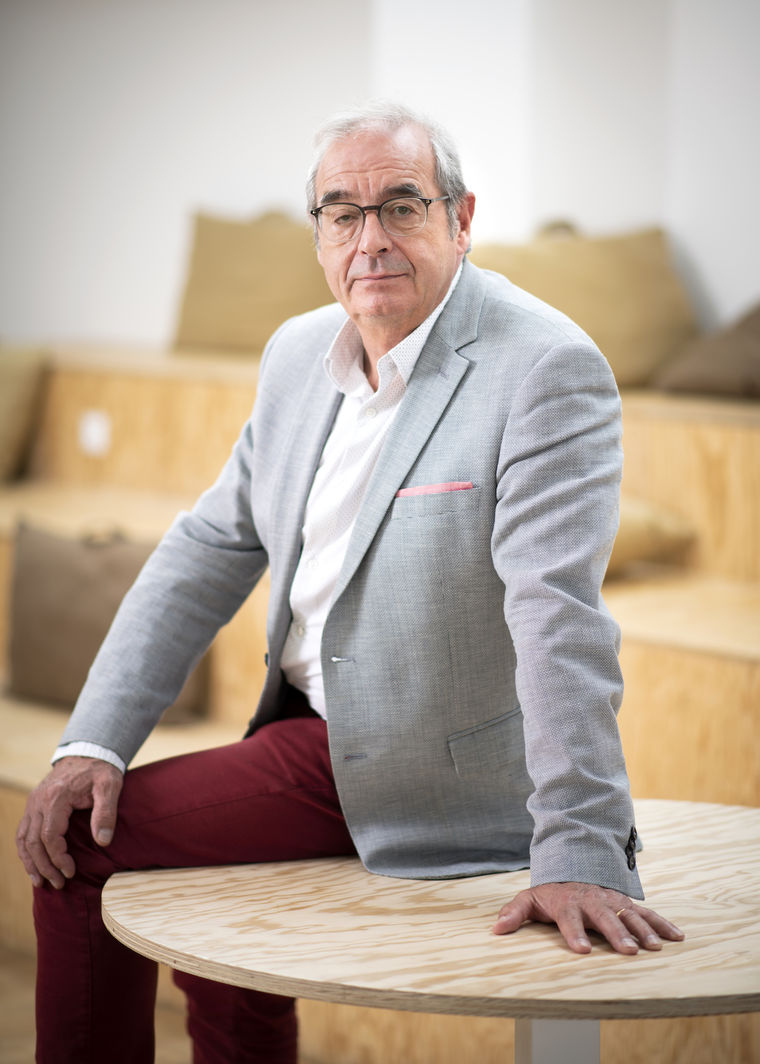
Pascal Picq © Marie Genel for Philonomist
Digital technology has also disrupted our social relations, particularly with the advent of remote work…
P.P.: Until the industrial revolution, there was a unity of time and place for social life and work, except for a few traders, diplomats, sailors, and soldiers. All activities revolved around places of residence and their commercial, political, festive, and religious events... With the concentration of the means of production, people came to live near mines and large factories. The modern world is the advent of a centripetal world, concentrated around the workplace, with a strong rural exodus. Then, starting in the 1960s, with the shift towards a service economy, there was a clearer geographical separation between places of work and residence, with restrictive commuting times. Today, we find ourselves again in a centrifugal world.
O.G.: With remote work, something extraordinary happened: work came back home!
P. P.: And the stress of work too! The separation between the world of work and private life is a recent invention. But we’re beginning to experience an untenable inversion. Work from home is just one of the many forms of remote work that are now unfolding in our digital economies.
O.G.: We still haven’t mastered hybrid work. Having part of the team in person and another online doesn’t work. Communication isn’t smooth enough, despite the technology. The virtual is confronting the real. But we’re only at the beginning of this transformation. The metaverse lets us envision an experience that will be increasingly “seamless”. We will also acquire new habits.
‘Fully remote work has allowed companies to access more talents, especially among women’
—Olivier Girard
P.P.: Surveys have been carried out on the sociability induced by social media. We’re realising that there are a lot of contacts and exchanges, but very few physical enactments. It’s troubling. There is a major anthropological and ethnological aspect at play here. We’re losing the “delousing” – the time monkeys spend removing their lice. When we meet, we feel a sense of sharing, and we pay attention to how we express what we’re going to say. One of the big problems of modernity is that we have lost these rites of passage.
O.G.: In business, we work precisely to restore rituals, to organise events, non-productive time. Work has entered the private sphere: for balance, personal life must also exist in the office! When I listen to young people, I can see that they want to recreate a social bond that has been very much damaged in recent years. We meet physically at work also in order to socialise. So it’s not so much that we need to invent different ways of working, it’s also that we need to think of different times in the office. Collective, informal... in addition to what can be achieved by remote work. This saves time in urban areas. It gives us a better work-life balance, it also increases diversity. Fully remote work has allowed companies to access more talents, especially among women.
P. P.: This is my digital and anthropological utopia: thanks to new remote collaborations, we’re discovering women and men of all backgrounds, all around the world – enough to reduce sexism and racism, because we’re starting seeing that there are skills everywhere.
‘Humans have cognitive abilities that machines will never have’
—Pascal Picq
The growth of AI is causing anxiety. Is the fear of being overtaken by machines justified?
P.P.: We’re afraid of being manipulated by machines because they affect our intellectual abilities. The problem is that we misunderstand the notion of AI. In the English sense of the term, intelligence is the ability to solve a complex problem through a set of data or information. This is what AI does: it solves problems faster than us. But we have never been afraid of cars because they go faster than us! Humans have cognitive abilities that machines will never have, such as the ability to generalise or conceptualise. As for machines, they have data processing capabilities that our overly slow brain cannot hope to develop.
O.G.: I completely agree with you, but I think that this anxiety comes from the fact that we imagine that these machines can show creativity, even develop self-awareness one day. When Kasparov was beaten in chess by Deep Blue, we were forced to abandon our romantic conception of human creativity. We realised that it’s the game itself that has become an elaborate calculation! As you say, it’s difficult to define intelligence precisely. We speak for example of weak AI and strong AI. A weak AI performs the specific tasks given to it as well as possible, it can certainly learn through deep learning, but it has an objective. Today we only do weak AI, which does extraordinarily repetitive things. We like to scare ourselves, but it’s obvious that machines aren’t aware of themselves, that they’re not creative and that they only know how to solve problems that we have already cleared up for them.
P.P.: An AI has no creativity in the cognitive sense of humans. It’s in this sense that we must understand statements such as “AI does not exist.” On the other hand, data analyses offer patterns that the human mind would have the greatest difficulty in extracting. It’s not about creativity, but about correlations and patterns offered by machines. We can decide that what it produced is a work of art – but that decision will be made by humans!
O.G.: Our relationship with the machine has always been a bit anxiety-provoking. We need a moment of learning. Science fiction literature reflects quite well this stage of acceptance a society goes through, in relation to technological evolution. When electricity was discovered, Mary Shelley wrote Frankenstein [1818], the story of a creature that becomes autonomous. At the time, it was thought that electricity was at the origin of life. More recently, it was Stanley Kubrick who revealed our fear of AI in 2001. A Space Odyssey [1968]. These works pose the same question: “What happens if I lose control?”
‘We see the arrival of machines as a technological revolution, when it’s really an anthropological revolution’
—Pascal Picq
P. P.: Mary Shelley was inspired by the work of Erasmus Darwin, the grandfather of Charles, and the first great modern physician who had the idea of applying electricity to medicine. In Western culture, we have a deep phobia of the autonomy of intelligence, whether it’s that of animals or machines. This is why our science fiction is so dystopian: every time, it goes wrong. We’re afraid of killer robots! The Japanese don’t share this mistrust. Each culture’s relationship to the machine reproduces its relationship to animals, an otherness that is sometimes considered intelligent, sometimes not. And here, Western Europe has a handicap. Chatting with an AI comes naturally to Japanese people, while it seems completely absurd to us. We see the arrival of machines as a technological revolution, when it’s really an anthropological revolution
O.G.: Absolutely. In Asia, people have no problem with the idea of having a digital twin. They’re perfectly comfortable with the fact that a double of themselves is shopping on the internet, for example, or that robots are providing nursing care.
P. P.: Western philosophy has a fundamental ontological fear of the autonomy of machines. However, with the Internet of Things, this autonomy is already there: we have voice assistants, smartphones, connected laptops that exchange information and are constantly evolving. This is the Darwinian digital space: everything is happening like in nature. We’re witnessing changes that are happening without us, thanks to learning algorithms. Let’s not forget that AI isn’t biomimetic, but bio-inspired. Biomimicry imitates the materials, structures, and forms of nature. Bio-inspiration is much more complex: it borrows from the mechanisms of innovation and adaptation in the living world. We always imagine AI as a robot – that’s absurd. We see machines, we don’t see their interactions. This world of connected and learning machines are evolving exactly like natural ecosystems, independently.
Won’t AI make jobs disappear?
P.P.: Each technological revolution raises the spectre of the replacement of humans or workers. The history of technology is rich with examples of policies that curb the rise of new technologies out of fear that they might cause social disorder. This phenomenon has existed since antiquity, but it has been amplified since the industrial revolution, because of the scale of economic, social, and political changes. These reactions are understandable, but they conceal a paradox. Take the Luddites: these textile workers destroyed the new machines that threatened their jobs, even though their jobs came from machines invented a few decades earlier! The question is, what tasks does technology destroy or create for each job?
‘Machines aren’t going to steal our work. They will allow us to focus on intellectually stimulating problems’
—Olivier Girard
O.G.: Machines aren’t going to steal our work. On the contrary, they will prevent us from doing repetitive tasks and allow us to concentrate on the most complex and intellectually stimulating problems. We forget that AI allows us to create new activities. For example, we have developed an AI to write the memoirs of the elderly: a device records what they say, asks them questions to verify the information, and a writer completes the work, to produce a hundred-and-fifty-page book they can give to their grandchildren. This is a new activity that is being created. AI will complement human work. This is also where it’s most effective: when humans learn from the machine and teach it too. My advice is to never leave an AI alone! Not because it could control us, but because it’s under our control that it brings us the most.
P.P.: All the experts on the future of work got it wrong when they announced it would come to an end or would have to be shared. Their mistake was to assume that there’s a constant volume of work. Where does such an idea come from?
But technological disruptions can have terrible social repercussions…
P. P.: The worst danger for the least skilled jobs isn’t digitalisation or automation, but outsourcing. The technological revolution does not threaten the most highly qualified professions, local or service work, or the jobs of the least qualified: they threaten those who are in between. As with every technological revolution, we’re seeing a bipolarization with the erosion of so-called “intermediate” professions, those of the more modest middle classes who are badly treated. Jean-Marc Vittori calls this the “hourglass effect”: each technological breakthrough upsets the socio-economic balance. My generation experienced the emergence of middle classes, especially with the creation of technical professions. These are the professions that are directly affected by new technologies. Hence – if we accept the work of Erik Brynjolfsson and Andrew McAfee – the “great break”, with the collapse of Western Europe’s middle classes. Getting a degree after two to four years at university used to be enough to guarantee entry into the middle class. That ceased to be the case twenty years ago. We’ve moved from a dromedary-shaped distribution of socio-economic indexes (like a Gaussian curve) to a curve in the shape of a camel, marked by a strong bipolarity.
O.G.: Other economists like Branko Milanović speak of an elephant-shaped curve, which amounts to the same thing.
Will technology end up freeing us from work, as some hope it will?
O.G.: I don’t believe in the disappearance of work. The three most advanced countries in robotics, namely Japan, South Korea, and Germany, have unemployment rates that are among the lowest, proof that technological change does not destroy long-term employment. In the 22nd century, we’re going to need a lot of robots to decarbonise the economy. Everything has to be reinvented: product offer, transport, house construction. And we will lack manpower for that. The talent shortage we are already facing in many professions is a good example.
‘There hasn’t been a technological revolution that has not been accompanied by economic, demographic, and territorial expansion’
—Pascal Picq
P.P.: Over the course of human evolution, there hasn’t been a technological revolution that has not been accompanied by economic, demographic, and territorial expansion, which in turn creates new activities. This is the logic of ecosystems: the more actors there are, the more activity there is. In countries with more women, young, and senior workers, there are more jobs and employment offers, which is also true with machines. The green economy ecosystem should create jobs: three hundred million job creations by 2030! But it’s not in this sector, which is definitely vital, that growth will occur.
O.G.: The whole difficulty is to organise this transition in a short period of time, and to finance it. We’re going to have to train a lot more people on a global or continental scale.
What is the role of private businesses in all of this?
O.G.: Companies are becoming aware of this issue. Before, there was a separation between an academic world that produced graduates and the company that hired them. Since the onset of mass unemployment in the West in the 1970s, and with the increased need for specialisation, companies have been involved in training. They also feel responsible for the employability of their employees and care about what will become of them once they leave the organisation. But training still needs to be improved. We must go further than asking ourselves what a country needs in ten years time in the major sectors, and start taking into account new needs, a different organisation of work, the power of digital technology, etc.
P. P.: This is the whole ambiguity of what de Gaulle called the “requirement of the plan”, when planification leads to failure. To plan isn’t to say what the future will be, but to prepare for what will not happen. In 2008, among the ten largest market capitalisations, there were oil companies, a few banks, Big Pharma, and Microsoft. Ten years later, seven more sprang from the digital sector, including Microsoft. Is this worrying? Not at all. It’s the certainties that make us anxious. The days when people had a job for life are long gone. Even the least skilled jobs will become skilled over time. The watchword here is training. This is a gift of our evolution: we’re a species that is capable of learning throughout the ages of life! Better still, it’s good for our cognitive abilities, life expectancy, and for society overall.
‘[On the issue of data], Europe benefits from a form of leadership through its normative standards’
—Olivier Girard
There are growing concerns about the power of private companies like Gafam [Google, Apple, Facebook, Amazon, Microsoft]. How far should technology be allowed to develop without any regulation at state level?
O.G: You need rules. Europe is ahead on these issues. The rest of the planet will follow – maybe not China, but at least the United States. Just as there are standards for car engines, there will be standards for algorithms and organisations to certify them. Take cloud computing: a few years ago, we didn’t ask questions about where our data was stored. Then France and Germany came up with the concept of “sovereign cloud”, by asserting the need to protect certain data which fall under their national sovereignty. Today, everyone is asking for sovereign features. This shows that Europe benefits from a form of leadership through its normative standards.
P.P.: The pandemic and the war in Ukraine have helped remind people of the importance of sovereignty. Following a logic of ecosystems, it’s crucial that we don’t neglect basic production activities (we saw the consequences of this in the case of masks, vaccines, then gas and wheat) and sovereignty, from fields to the European cloud.
Should we sometimes consider renouncing a technology?
P.P.: There’s no simple and unequivocal answer to this question. Everything depends on the acceptance of technologies. In China, people accept what is called the “celestial network”, this global surveillance system that tracks you through facial recognition. While in California, people were seen slapping those wearing Google Glass on the street because they didn’t want to be filmed. The way technologies are accepted is radically different from one culture to another. Digital technology in China isn’t the same as in California!
So it’s simply a matter of cultural acceptance?
O.G.: Cultural acceptance plays a role, of course, but I think we shouldn’t underestimate the notion of adapting to change, which is necessary to accompany progress and technological advances. I can’t spontaneously think of a technology that I would find deviant to the point of saying that we should beware of it… Once again, it’s the use that we make of it that can pose a problem. One of the real risks today is that we become too dependent on digital technology. [René] Barjavel’s novel Ashes, Ashes [1943] describes a widespread breakdown that reveals our helplessness without technology. What will happen to us if everything stops working? In the event of a breakdown too, adaptation is even more necessary!
P.P.: It was the Carrington Event, a series of solar flares, that seriously disrupted electrical circuits, such as telegraphs. It happened in 1859, the year of another terrestrial eruption, that of Charles Darwin’s The Origin of Species. Back to evolution!
Picture © Marie Genel for Philonomist
