


is a journalist and philosopher of technology with degrees from France’s École Normale Supérieure in Lyon and HEC-Paris, where she specialised in innovation and media, before joining Philonomist’s editorial team.
Picture: © CP
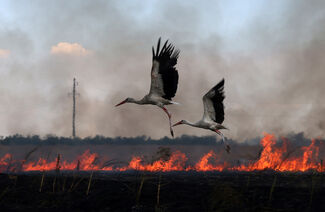
Stork fly over a burning field near town of Snigurivka, Mykolaiv region on July 4, 2023, amid Russian invasion in Ukraine. © Anatolii Stepanov / AFP
Dear reader,
Behind the front line in the war in Ukraine, a more discreet battle is raging over agricultural soils. Since 2024 and after a 20-year freeze of the property market, plots of up to 100,000 hectares can once again be purchased. Presented as a crucial step in the modernisation of the country, the reform nevertheless raises questions: if Ukraine wins the war, who will reap the benefits of all its chernozem, i.e. dark-coloured soil rich in humus and minerals, and therefore extremely fertile?
Historically, Ukrainian farm workers were forced to work as serfs under Polish then Russian masters, then, following the collectivisation of land, for the Soviet state. In the 1990s, these former kolkhoz workers were given property certificates for small parcels of land – which they mostly resold, under hardship, to former high ranking figures of the Soviet administration. The concentration of land was then so extreme that in 2001, the government had to adopt a moratorium on the privatisation of public land and the transfer of private ones. But the result wasn’t quite what the government had hoped for: between 2001 and 2020, the concentration of control of the land continued in other ways.
Without the means to exploit their own land themselves, millions of owners started putting small plots a few hectares up for rent, for negligible sums. Thus “agro-holdings” were able to cleverly exploit the moratorium by benefiting both from cheap land and the flexibility of the rental system.
Then, in 2021, the moratorium was suddenly lifted, to mixed reaction: part of the Ukrainian population now fears that some companies will use their pre-emptive right to purchase the land they’re already exploiting; others fear that these big farming businesses will monopolise public subsidies, at the expense of small Ukrainian farmers.
It’s therefore easier to understand why 64% of Ukrainians are against opening up the country’s farmland to the market. In December 2022, a coalition of student and farmers’ organisations, as well as NGOs, asked the government to suspend the agricultural reform bill and all land transactions for the duration of the war and in the after-war period, in the name of “the preservation of the country’s territorial integrity.” As professor of Ukraine’s National Academy of Science Olena Borodina said in January 2023, “thousands of young people in the countryside, boys and girls, are fighting and dying at war. [...] The process of purchasing and selling land is becoming increasingly liberal and subject to publicity. This is truly threatening Ukrainians’ rights to their land, for which they are dying.”
“Whatsoever [man] hath mixed his labour with, and joined to it something that is his own, and thereby makes it his property”
—John Locke
Beneath this plea lies a philosophical question: to whom should land rightfully belong, especially in times of war?
For John Locke, we only own what we transform through our efforts. “Whatsoever [man] removes out of the state that nature hath provided, and left it in, he hath mixed his labour with, and joined to it something that is his own, and thereby makes it his property.” (Second Treatise, II, §27). By working the land, we mix with it, so to speak. And, in their way, agro-holding companies do exploit the land… But what about the citizens giving their life to defend it, as Olena Borodina points out? Are they not also joining to it something of their own, in the sense meant by Locke? According to the latter, we only form society in order to secure and defend our property and set rules so that everyone knows what truly belongs to them. A Ukrainian state which fails to protect the property rights of citizens giving their lives to defend their land would therefore lose legitimacy and cohesion. Especially if it favours holding companies – foreign or owned by Ukrainian oligarchs –, registered in tax havens, and led at the whim of their French, American, or Saudi leaders.
But can the government afford to listen to these sceptical voices? Since the 2010s, the integration of Ukraine in the globalised market has massively indebted them to Western countries and their institutions.
In 2022, despite the ongoing war, the country paid back 496 million dollars to the World Bank and 2 billion to the IMF – that’s 400 million more than what the country invested in education. When the time to rebuild comes, at a heavy cost, Ukraine’s creditors could find themselves in a strong negotiating position, which would allow them to impose their own conditions… Even if it means weakening the country’s social contract.
Apolline Guillot
