


is a journalist and editorial advisor at Philonomist. She was previously the chief editor of Le Monde des Débats (1999-2001), Courrier International (2001-2005) and Le Monde (2005-2008), before joining the financial newspaper La Tribune as deputy managing editor. She won a national journalism award for her coverage of the financial crisis, which she also wrote about in her book Capital Sin. The Story of the Financial Crisis (2009).
Picture: © Elie Axas

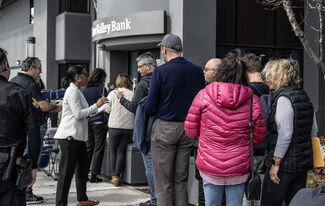
Since last week, the world of tech and finance has been shaking. The bankruptcy of Silicon Valley Bank, on 10 March 2023, called to mind that of the Lehman Brothers, at the origin of the 2008 financial crisis. What is in question, this time, is the arrogance and inbreeding of the tech sector, which thought it could escape the rules that bind ordinary mortals.
Hollywood screenwriters are no doubt already hard at work. The collapse in less than three days of the main tech bank, the Silicon Valley Bank (SVB) of Santa Clara, California, and of the Signature Bank of New York, has all the ingredients for a spectacular series – thrilling, terrifying, but also uplifting at the same time.
What’s breathtaking is that it all happened in four days. Thursday, March 9, 2023 at around 9 a.m. (west coast), rumours of the bank’s difficulties caused customers to withdraw their money en masse. The next day, in the morning, the SVB – ranked sixteenth among America’s top banks – was closed by the banking supervisory authority, the FDIC (Federal Deposit Insurance Corporation). That’s when the entire venture capital and tech community realised that the deposit guarantee, set at $250,000, only covered a small part of its cash flow needs, and that the payment of wages was likely to be blocked. On Sunday, March 12 at 6:15 p.m. (East Coast), the Treasury Secretary Janet Yellen and the Chairs of the Federal Reserve and FDIC jointly announced that all customers will be able to access all of their deposits at both banks starting Monday morning. This high-speed bankruptcy, the biggest and fastest in the US since 2008, was managed masterfully. But this didn’t stop nervousness from setting in on the financial markets.
A legitimate fear
If the fall of SVB is so terrifying, it’s because it awakens the not-so-old fears of the 2008 financial crisis, which was also triggered by the bankruptcy of an emblematic bank, Lehman Brothers. Banking systems across the world faltered as a result, leading to a major recession in the real economy, and widespread individual misfortunes that are still being felt fifteen years later. Many remember how authorities deployed unprecedented means to save the banks, including some irresponsible choices. Some argue that they were too rash in closing the budgetary floodgates, prolonging for several years the economic stagnation and its serious consequences – unemployment, poverty, and social crises leading to mass protests, such as those of the Arab Spring.
‘The fear of contagion from the financial crisis is anything but irrational’
The fear of contagion from the financial crisis is anything but irrational: it has happened before, and most adults today remember it well. The philosopher Martin Heidegger made a distincti
…Subscribe to Philonomist and gain free access to all our content and archives for 7 days. You'll also receive our weekly newsletter. No commitment. No bank details required.
You're already subscribed to Philonomist via your employer?
Connect to your account by filling in the following details (please provide your professional email address).
